

A US patient in San Diego is researching gastric sleeve in Tijuana. She does not start on Google. She opens ChatGPT and asks "Is gastric sleeve in Tijuana safe for US patients?" Then "How much does gastric sleeve cost in Tijuana?" Then "Best bariatric surgeons in Tijuana for revision surgery." Then "What happens if I have complications after returning to California?"
Four AI answers. The practice the patient eventually contacts will see one form submission, weeks later, and call it a lead.
The practice will not see the four answers that built the shortlist.
The practice is still watching keyword rankings and lead counts. The patient is already asking AI systems to create the shortlist.
That gap is the whole article.
The 30-second summary
ChatGPT prompt tracking is the recurring measurement of how AI assistants answer the questions bariatric patients actually ask before they contact any clinic.
It is not a one-time check. It is a measurement discipline that complements traditional SEO tracking, lead tracking, and consultation tracking. It does not prove causality between AI answers and bookings. It does not guarantee that any specific change will improve AI visibility. What it does is reveal whether the practice, its doctors, its procedures, its pricing, its reviews, and its trust signals can be found, named, and explained by the AI systems patients are using.
For bariatric practices serving US patients across the border, prompt tracking is becoming the AI-era version of rank tracking. It adds a missing layer to existing measurement.
This is where SEO, GEO, AEO, and zero-click measurement overlap. The full operator-side argument for this measurement gap is in our zero-click marketing for medical tourism breakdown. This article zooms into the practical tracking layer.
Keyword rankings show where your pages rank. Prompt tracking shows how your practice is explained.
Why keyword tracking is not enough anymore
Traditional SEO measurement is still useful. None of it goes away.
- Keyword rankings still indicate visibility in organic search
- Organic sessions show how much traffic is reaching the site
- Clicks and impressions reveal which pages are doing work
- CTR identifies underperforming title tags and snippets
- Form submissions remain the bottom-of-funnel conversion event
This stack remains necessary. It is no longer sufficient.
What it misses, in 2026, is the entire layer of patient research happening inside AI assistants. The patient who asks ChatGPT a question and gets a useful answer may not click anything. She may not visit your site. She may not appear in any analytics tool. She may still form a strong opinion about which clinics belong on her shortlist, and which ones do not.
What traditional SEO tracking cannot tell you:
- Whether your practice is mentioned when patients ask about bariatric surgery in your city
- Whether AI assistants name your competitors instead of you
- Whether AI assistants cite your clinic site, an external profile, or a competitor source when answering
- Whether AI assistants reproduce incorrect or outdated facts about your doctors, procedures, or pricing
- Whether your surgeons appear by name or get aggregated into generic phrasing
- Whether AI assistants connect your surgeons to the correct procedures
- Whether your safety, aftercare, or pricing context shows up in answers at all
The patient may decide who is worth contacting before the practice sees any click. Rank tracking and analytics will not show you that decision happening.
What prompt tracking means for bariatric practices
Prompt tracking is a recurring measurement process where the practice runs a fixed set of patient-like prompts across ChatGPT, Gemini, Perplexity, Claude, and Google AI Overviews on a recurring schedule, then records what each system returns.
What gets recorded for each answer:
- Was the practice mentioned at all?
- Was the surgeon mentioned by name?
- Was the correct procedure connected to the correct surgeon?
- Were competitors mentioned?
- Were any sources cited, and which ones?
- Was the pricing context correct or close to correct?
- Were credentials presented accurately?
- Were reviews or patient experience themes referenced?
- Was safety or aftercare addressed?
- Was the answer accurate, incomplete, outdated, or wrong?
The output is not a screenshot of one favorable ChatGPT answer to show in a meeting. The output is a recurring spreadsheet that lets the practice see patterns across systems and across time.
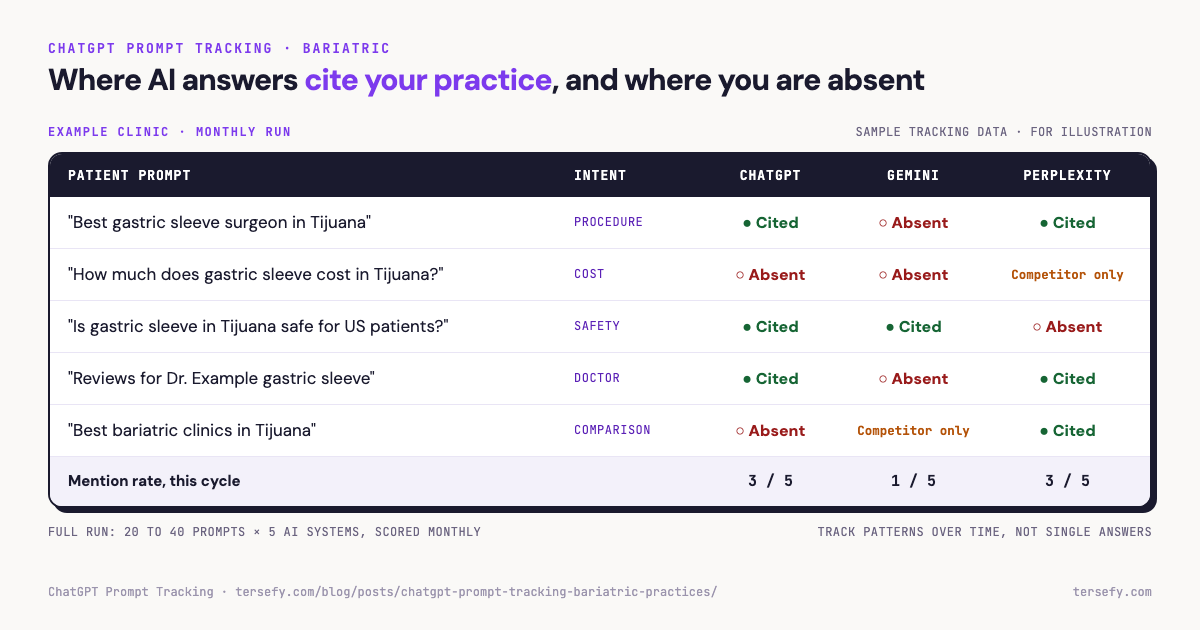
Prompt tracking is not "checking ChatGPT once." Checking ChatGPT once is a moment of theater. Recurring measurement is a discipline.
The bariatric prompt set every practice should track
The exact prompt set depends on the practice's procedures, surgeons, city, and patient objections. The following six groups give every bariatric practice serving US patients a defensible starting point. Pick 5 to 8 prompts from each group for a total of 30 to 40 core prompts.
Group 1: Procedure prompts
- Best gastric sleeve surgeon in Tijuana
- Gastric sleeve vs gastric bypass in Mexico
- Bariatric revision surgery in Tijuana
- Lap band conversion to gastric sleeve Mexico
- Mini gastric bypass in Tijuana
Group 2: Cost prompts
- How much does gastric sleeve cost in Tijuana?
- What is included in a bariatric surgery package in Mexico?
- Gastric sleeve Mexico all-inclusive package
- Why is bariatric surgery cheaper in Mexico than the US?
Group 3: Safety prompts
- Is gastric sleeve in Tijuana safe for US patients?
- How do I verify a bariatric surgeon in Mexico?
- What happens if I have complications after returning home?
- What hospital standards should I look for in Tijuana?
Group 4: Doctor and entity prompts
- Dr. [Name] bariatric surgeon Tijuana
- Is Dr. [Name] qualified for gastric sleeve?
- What procedures does Dr. [Name] perform?
- Reviews for Dr. [Name] gastric sleeve
Group 5: Recovery and aftercare prompts
- How long do I need to stay in Tijuana after gastric sleeve?
- When can I fly after bariatric surgery in Mexico?
- What follow-up do I get after returning to the US?
- What is recovery like after gastric sleeve in Mexico?
Group 6: Comparison prompts
- Best bariatric clinics in Tijuana
- Tijuana bariatric surgery vs US bariatric surgery
- Gastric sleeve in Mexico vs Arizona
- Bariatric surgeon reviews Tijuana
These prompts approximate what real patients are typing into AI assistants. They are not optimized for the practice. They are optimized for patient intent. That is the point.
What to score in each AI answer
The scoring framework needs to be simple enough that a coordinator can maintain a spreadsheet without dashboard tooling. Each prompt run gets a row. Each row scores the following categories.
Mention status. Mentioned, not mentioned, competitor mentioned, category mentioned only (the answer talks about Tijuana clinics but does not name yours).
Doctor match. Correct doctor named, wrong doctor named, doctor missing, doctor mentioned with wrong specialty.
Procedure match. Correct procedure connected to surgeon, incomplete procedure description, wrong procedure connected to surgeon.
Source quality. Which sources did the AI cite. Clinic site, external directory, review platform, news or interview, or no source at all.
Pricing context. Clear with package detail, vague, missing entirely, or derived from a competitor.
Safety context. Clear with practice-specific information, vague generic, or missing.
Aftercare context. Clear with practice-specific information, vague generic, or missing.
Review specificity. Specific reviews referenced, generic reviews referenced, or no reviews mentioned.
Accuracy. Accurate, incomplete, outdated, or wrong.
Sentiment and framing. Favorable, neutral, skeptical, or competitor-favorable.
Actionability. Does the answer move the patient forward in her decision, or does it stop her.
This is a 12-column spreadsheet. Most practices can build it in an afternoon. The goal is not academic-style precision. The goal is a recurring measurement asset the practice owns.
What bad AI answers reveal
When prompt tracking surfaces a bad answer, the answer itself is a diagnostic. Each failure mode points to a fixable upstream cause.
AI cannot find the doctor by name. Usually means the doctor's external profile is thin or inconsistent. Doctoralia, RealSelf, hospital directories, and board verification sources may not match what the clinic site claims.
AI connects the doctor to the wrong procedure. Procedure-to-doctor mapping is broken. The surgeon's bio probably does not link to the procedures she performs, and the procedure pages do not name her as a surgeon.
AI names competitors but not the practice. Competitors are more extractable. Their pages may be richer, their external profiles cleaner, their reviews more specific.
AI gives pricing from competitors. Hidden pricing forces the AI to look elsewhere. The competitor with published pricing controls the narrative.
AI says pricing is unavailable. Same root cause. The practice has not made pricing context retrievable.
AI cannot verify credentials. External corroboration is weak. Board certifications, hospital affiliations, and credential databases may not be aligned with what the site claims.
AI cites thin directories but not the clinic site. The clinic site may be technically poor, not indexed properly, or written in a way that resists extraction.
AI mentions old or wrong information. Stale content, outdated bios, or out-of-date pricing pages. Or external sources that have not been corrected.
AI gives generic safety advice instead of practice-specific context. The practice does not have a substantive safety page. The patient gets aggregated boilerplate.
AI cannot explain aftercare. The cross-border patient's biggest concern is silent because there is no aftercare page to extract.
Each diagnostic points to a fix. The diagnostics are often more useful than the score itself.
How prompt tracking connects to content strategy
Prompt tracking should not sit in a quarterly report deck. It should feed the next content sprint.
When prompt tracking surfaces a gap, the response is a content fix.
- AI cannot answer "what BMI do I need for gastric sleeve" → improve candidacy sections on procedure pages
- AI cannot name the surgeon for a specific procedure → improve doctor pages and procedure-to-doctor linking
- AI pulls competitor pricing → improve pricing context and package transparency on the procedure page
- AI cannot explain aftercare → create a dedicated aftercare page for US patients
- AI ignores reviews → improve review specificity and procedure-page placement
- AI connects the wrong doctor to bypass → fix procedure-doctor mapping in both directions
- AI cites a thin directory but not the clinic site → restructure the procedure page for extraction
- AI repeats outdated facts → update content and request corrections on external sources
Prompt tracking is most valuable when its output drives a content sprint, not when it produces a screenshot for a board meeting.
How often to run prompt tracking
Recommended cadence depends on practice resources.
Monthly works for most established practices. Enough frequency to catch directional changes. Not so often that team capacity is consumed by tracking instead of fixing.
Weekly makes sense during a major site rebuild, a new surgeon onboarding, a pricing page launch, or any content sprint where the practice wants to see whether changes are landing in AI answers.
Quarterly is the minimum defensible cadence for slower-moving baselines or resource-constrained practices. Less than quarterly is essentially not tracking.
Specific guidance on what one cycle looks like:
- 20 to 40 core prompts
- 5 AI systems (ChatGPT, Gemini, Perplexity, Claude, Google AI Overviews)
- 1 monthly run, scored in the spreadsheet
- Review trends every 90 days, not every single month
AI answers can vary across runs even for the same prompt. Do not overreact to a single answer. Track patterns over time. A competitor mentioned once in a single Perplexity answer is noise. A competitor mentioned in three consecutive months across multiple systems is signal.
Avoid claiming perfect measurement. Prompt tracking is directional, not absolute. It is closer to brand-tracking surveys than to keyword rank data.
The prompt tracking dashboard
A simple dashboard, built in a spreadsheet, can surface the metrics the practice actually needs to act on. No expensive tooling required at first.
What to show:
- Total prompts tracked in the cycle
- Percentage of prompts where the practice is mentioned (mention rate)
- Percentage of prompts where the correct doctor is mentioned (doctor-mention rate)
- Percentage of prompts where the correct procedure is connected to the correct doctor (procedure-mapping rate)
- Competitor mention frequency, ranked by competitor
- Source count and source quality (clinic site, directory, review platform, news, none)
- Pricing context score across all pricing-related prompts
- Safety context score across all safety-related prompts
- Aftercare context score
- Review specificity score
- Number of wrong, outdated, or incomplete answers
- Top three content gaps identified this cycle
- Top three next actions for the next content sprint
Some practices add a comparison column showing month-over-month or quarter-over-quarter delta. Useful but not required at the start. The first goal is establishing the baseline. For a Spanish-language companion that maps these signals to pipeline KPIs, see visibilidad en IA no es pipeline.
What Tersefy measures
Tersefy prompt tracking is not about vanity screenshots of a single favorable AI answer. The questions that better predict modern bariatric practice growth are sharper:
- Can AI find the practice when patients ask about its city?
- Can AI name the doctors at the practice individually?
- Can AI connect each doctor to the correct procedures (sleeve, bypass, mini-bypass, revision, band conversion)?
- Can AI explain pricing context for the practice, or does it default to competitor pricing?
- Can AI identify review themes that match the practice's actual outcomes?
- Can AI describe the safety and aftercare protocol with practice-specific detail?
- Can AI cite sources beyond the clinic's own site (directories, hospital pages, interviews, external profiles)?
- Which competitors appear more often in AI answers for the practice's core prompts?
- Which sources are causing the AI to form its answer, and which are missing from the corpus?
- What content gaps need fixing first to move the next answer?
These connect to the broader SEO for bariatric surgeons system, the gastric sleeve procedure page structure, and the review specificity work in our bariatric surgeon reviews article. Prompt tracking is the measurement layer that ties them together.
Practical prompt tracking workflow
A step-by-step workflow most clinics can execute without new tools.
- Pick 20 to 40 patient prompts. Pull from the six groups in this article. Adjust for the practice's procedures, doctors, and city.
- Group them by intent. Procedure, cost, safety, doctor, recovery, comparison. Keep the groups intact so trends within each intent are visible.
- Run them across five AI systems. ChatGPT, Gemini, Perplexity, Claude, and Google AI Overviews. Use a fresh chat for each prompt to avoid memory contamination across answers.
- Record the answer, mentions, sources, competitors, and accuracy. Use the 12-column scoring framework from earlier in this article.
- Tag issues by failure mode. Doctor missing, wrong procedure mapping, competitor pricing, missing aftercare, generic safety, and so on.
- Prioritize fixes by frequency and severity. If the same gap shows up in 20 of 30 prompts, that is the first content sprint. If a gap shows up once, monitor before acting.
- Update pages, reviews, external profiles, pricing, safety, and aftercare based on the prioritized list. The fix is content, not a tracking change.
- Rerun monthly. Same prompts, same systems. Compare answers month over month, not just to the prior single run.
- Compare trends every 90 days. A 90-day window can smooth out variance and reveal whether content fixes are actually landing in AI answers.
- Use self-reported attribution at consultation. Ask new patients: "Before you contacted us, what did you read or see about us?" Cross-reference with the prompt tracking themes. If patients are referencing answers that match the practice's strong-mention prompts, the work is likely moving downstream.
This workflow does not require an agency. It requires a coordinator, a spreadsheet, and a recurring calendar slot.
Start with the Scorecard
If you want a starting baseline of whether AI can already find, name, and explain your bariatric practice, start with the Free AI Visibility Scorecard. It will surface a first-pass view of which surgeons are findable, which procedures are connected, where external sources support your claims, and where the gaps are.
It will not promise that AI will surface your clinic tomorrow. No one can promise that. What it will tell you is whether the evidence layer your practice depends on is currently producing clean answers in AI systems or producing nothing at all.
Quick answers
What is ChatGPT prompt tracking?
ChatGPT prompt tracking is the recurring measurement of how AI assistants answer the questions patients actually ask before contacting a clinic. For bariatric practices, it complements traditional SEO and lead tracking by revealing whether the practice, doctors, procedures, pricing, and reviews appear in AI answers across ChatGPT, Gemini, Perplexity, Claude, and Google AI Overviews.
Why should bariatric practices track AI answers?
Patients may form their shortlist of clinics inside AI assistants before any click or form submission. Practices that do not track those answers may miss a high-leverage part of the decision journey. Prompt tracking does not guarantee outcomes, but it can reveal whether the evidence patients are encountering is accurate, favorable, and complete.
Which prompts should a bariatric practice track?
A defensible starting set covers six groups: procedure (sleeve, bypass, revision), cost, safety, doctor and entity, recovery and aftercare, and comparison prompts. Most practices benefit from 20 to 40 core prompts adjusted for their specific procedures, surgeons, and city.
How often should prompt tracking be done?
Monthly works for most established practices. Weekly is useful during a major content sprint or site launch. Quarterly is the minimum defensible cadence. AI answers can vary across runs, so track patterns over time rather than reacting to any single answer.
Does prompt tracking prove that AI caused a lead?
No. Prompt tracking is directional measurement, not causal proof. It cannot tell you that a specific AI answer produced a specific booking. What it can do is reveal whether the practice is visible, accurate, and competitive in the AI answers patients are encountering, and pair with consultation self-reported attribution to triangulate influence.
How is prompt tracking different from SEO rank tracking?
SEO rank tracking measures where the practice's pages appear in traditional search results. Prompt tracking measures how AI systems explain the practice when patients ask questions, often without any click. Rank tracking is about visibility in a list. Prompt tracking is about visibility in an answer. Both complement each other; neither replaces the other.