

Tersefy took 5 VIDA surgeons from invisible in ChatGPT, Perplexity, and Gemini to AI-recommended in 6 months. Across the 4-surgeon cohort with complete financial reporting, ad spend dropped 50%, surgeries grew 13%, generating a 100x ROI on Tersefy's fee.
Important context & disclosure
Tersefy's founder, Emilio Alcolea, previously served as Chief Sales & Marketing Officer at VIDA Wellness & Beauty Center (Tijuana). This case study is an operator-led reference implementation built inside a real Tijuana medical-tourism environment. The results reflect the combined impact of AI visibility, faster patient response speed, review quality, and funnel operations. They should not be read as a guarantee of identical outcomes for future clients.

VIDA Wellness & Beauty Center
Tijuana's largest medical tourism clinic. 40+ specialists across 7 service lines: plastic surgery, bariatric surgery, medispa, injectables, regenerative medicine, hair restoration, and dental. Thousands of US and Canadian patients per year. Located in Zona Rio, minutes from the San Ysidro border crossing.
VIDA had everything: board-certified surgeons, accredited facilities, competitive pricing, thousands of reviews. What they didn't have was AI visibility. When patients asked ChatGPT for a surgeon in Tijuana, VIDA's doctors were not being named.
Highlights
From invisible to dominant in 6 months
All five VIDA surgeons became machine-readable, extractable, and citable across AI engines through 46 GEO-optimized articles, entity architecture, and the AI Closer System for sub-60-second patient response. Across the 4-surgeon cohort with complete financial reporting for the 6-month period, Tersefy's system produced a 50% reduction in ad spend and 13% more surgeries.
How the most credentialed surgeons in Tijuana became invisible overnight
Between 2023 and 2025, something changed in how American patients chose surgeons in Tijuana. The change was quiet. No announcement. No algorithm update notification. No warning from Google.
Patients stopped searching "best bariatric surgeon Tijuana" on Google and started asking the same question to ChatGPT. They stopped scrolling through RealSelf reviews and started uploading surgical quotes to Gemini for a second opinion. They stopped calling coordinators to ask about credentials and started asking Perplexity to verify board certifications.
VIDA didn't notice at first. The Instagram was still active. The Google Ads were still running. The five-star reviews kept coming. The monthly agency report still showed green numbers. But something felt off. Coordinators reported fewer calls from US patients. The ones who did call were different. They already knew the pricing. They already knew the credentials. They already had a shortlist. And VIDA wasn't on it.
The problem wasn't VIDA's clinical quality. Dr. Rodriguez had a PhD from UT Houston and 7,800 procedures. Dr. Quiroz had 37 years and 3,000 facelifts. Dr. Fuentes trained under the same American pioneer who invented modern facelift technique. Dr. Castaneda had 5,000 procedures and ISAPS membership. Dr. Quiros Lim trained in Israel and published peer-reviewed research on implant safety.
The problem was that none of this existed in a format AI could read.
Credentials were embedded in images. Pricing was hidden behind "Call for quote." Procedures were listed five to a page with no individual structure. The doctor profiles were sliders and PDFs. Beautiful for Instagram. Completely invisible to ChatGPT.
Meanwhile, competitors with half the credentials but properly structured websites were being recommended by name. A surgeon with 200 procedures was showing up in ChatGPT. A surgeon with 7,800 was not. The difference wasn't skill. It was digital architecture.
That is where Tersefy started.
Five surgeons. Zero AI visibility.

Bariatric surgery. 7,800+ procedures. PhD from UT Houston. Fellow of the American College of Surgeons. Dual licensed US and Mexico. Inventor of Stomach Sparing Gastric Sleeve.

Plastic surgery. 37 years, 3,000+ facelifts. Founder of VIDA (2013) and Cosmed Clinic (1989). Trained under Dr. Bruce Connell. Deep plane facelift specialist. $8,000-$12,000.
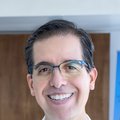
30+ years. Fellow of The Rhinoplasty Society. Trained under Dr. Bruce Connell. Specializes in rhinoplasty, facelift, body contouring. Rhinoplasty from $4,500.

12+ years, 5,000+ procedures. Plus-size body contouring specialist. Mommy makeover, tummy tuck, body sculpting. Starting from $7,500.
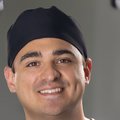
Internationally trained in Israel (Ben-Gurion University, Chaim Sheba Tel HaShomer/Tel Aviv University). Body contouring for post-massive weight loss and breast augmentation. Peer-reviewed publications on breast implant safety (PMID: 33799099).
The team that went invisible
VIDA isn't an assembled team. It's a research-depth roster built over 37 years, anchored by a Chief Surgeon who founded two clinics (CosMed 1989, VIDA Wellness 2013), and staffed with surgeons who trained under US plastic surgery pioneers, published peer-reviewed research in Circulation and Surgical Technology International, and hold board certifications in both US and Mexican medical systems.
Dr. Alejandro Quiroz Tejeda - Chief Surgeon
Over 37 years. 3,000+ facelift procedures. Founder of CosMed Clinic (1989) and VIDA Wellness (2013). Trained under US plastic surgery pioneers Bruce Connell, Baker & Gordon, Robert Flowers, and Richard Mladick. Deep Plane Facelift specialist. Licensed US and Mexico.
Full credentials at VIDA →Dr. Gabriela Rodríguez Ruiz, MD, PhD, FACS - Bariatric Surgeon
15 years. 7,800+ successful bariatric surgeries. PhD in Molecular Biology and Genetics from UT Health Science Center Houston. Fellow of the American College of Surgeons. Master Surgeon of Excellence (Surgical Review Corporation). 20+ peer-reviewed publications spanning Circulation and Surgical Technology International. Developer of two novel bariatric techniques: the Stomach Sparing Gastric Sleeve™ and the Double Buttress Technique™. Bilingual, licensed in both countries.
Full credentials at VIDA →Dr. Enrique Quirós Lim - Plastic Surgeon
Medical training across three continents: Monterrey Medical School, General Surgery residency at Ben-Gurion University (Israel), Plastic Surgery specialization at Chaim Sheba Tel HaShomer (Tel Aviv University). CMCPER Board Certificate No. 2369. Published peer-reviewed research on silicone breast implant safety, including PMID 33799099 on autoimmune dysautonomia. Body contouring and breast augmentation specialist.
Full credentials at VIDA →Dr. Juan Carlos Fuentes Amezcua - Plastic Surgeon
30 years in private practice. Graduate of University of Guanajuato, A.H. Robins Award for highest grades in class (1988). Chief of Residents in Plastic Surgery at IMSS Guadalajara (1993-1994). Completed US-based Aesthetic Surgery Fellowship at the Connell Aesthetic Surgery Network in Santa Ana, California under Dr. Bruce F. Connell MD FACS. Facial rejuvenation and rhinoplasty specialist. ASAPS member, San Diego International Plastic Surgery Society.
Full credentials at VIDA →Dr. Carlos Castañeda Reichert - Plastic Surgeon
12 years of practice, 5,000+ procedures. Graduate of UABC School of Medicine (1995-2001). CMCPER Board Certified since 2009. AMCPER and ISAPS member. Specializes in body contouring, body reconstruction after massive weight loss, and high-definition liposculpture (abdominal etching).
Full credentials at VIDA →Five surgeons. Fellowships at Connell Medical Clinic, Chaim Sheba Tel HaShomer, Baker & Gordon, Ben-Gurion University, Brown Foundation Institute of Molecular Medicine. Peer-reviewed publications in Circulation, Cardiovascular Genetics, European Journal of Clinical Investigation, Surgical Technology International, and the Journal of Surgical Oncology. Board certifications across CMCPER, CMCG, FACS, CCPERBC, ASAPS, and ISAPS.
They had the credentials. They didn't have the visibility. AI engines couldn't cite what they couldn't extract. Tersefy changed extraction, not credentials.
What AI said before we started
We tested 80+ real patient prompts across ChatGPT, Gemini, Perplexity, and Google AI. Here is what we found.
Dr. Juan Carlos Fuentes (VIDA Wellness & Beauty Center): 30+ years, trained under Dr. Bruce Connell.
Actual AI responses, April 14, 2026
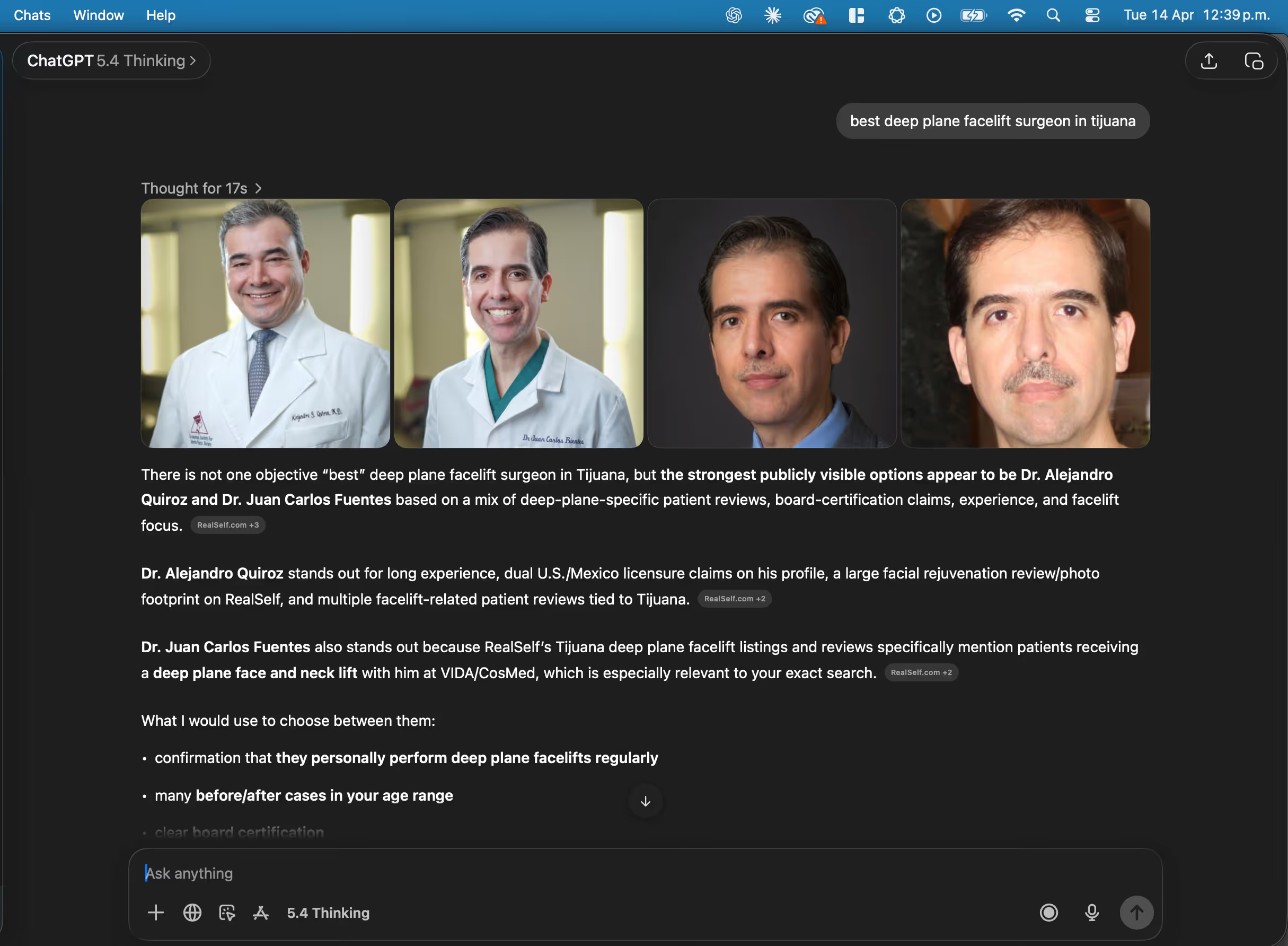
ChatGPT 5.4 Thinking response, April 14, 2026. Dr. Quiroz and Dr. Fuentes recommended by name. Click to zoom.
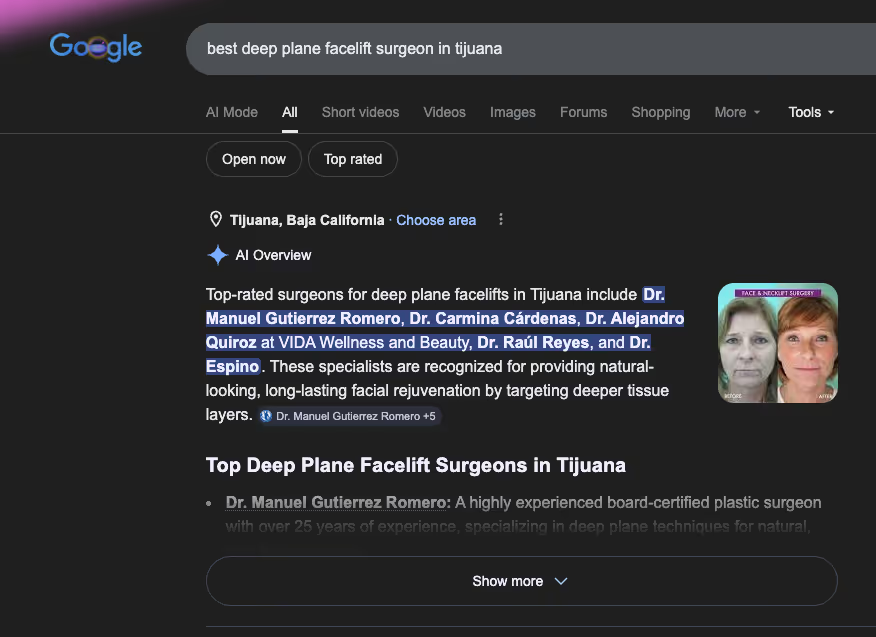
Google AI Overview, April 14, 2026. Dr. Quiroz named at VIDA Wellness & Beauty Center. Click to zoom.
The 4-surgeon financial cohort: 50% less ad spend, 13% more surgeries.
Semester-over-semester comparison across 4 plastic surgeons with complete financial reporting for this period. Data from VIDA CRM and financial records.
Financial data shown for 4 of the 5 surgeons in the engagement. Complete pre/post figures available for this reporting period.
Definitions: CX = completed surgeries (not booked, not quoted, completed). CAC = total ad spend divided by completed surgeries per quarter. Citation Share = percentage of test prompts where the surgeon is named by AI across ChatGPT, Gemini, Perplexity, and Google AI.
Comparison period: Semester 1 (baseline): Q4 2024, Q1 2025, Q2 2025. Semester 2 (with Tersefy): Q3 2025, Q4 2025, Q1 2026.
What changed: Tersefy deployed entity architecture, schema markup, and GEO content. AI Closer System implemented for faster patient response. Review generation system activated. Ad budgets were intentionally reduced as AI-driven leads increased. No major pricing, staffing, or promotional changes during the period.
Attribution note: The financial improvements reflect the combined impact of AI visibility (GEO), faster response times (AI Closer), and improved review quality. We do not claim that GEO alone produced these results. The gains come from the full system: visibility + credibility + conversion speed.
Data source: All financial data extracted from VIDA Wellness & Beauty Center CRM (VidaTool) and verified against internal accounting records.
VIDA reduced ad spend by $246,627 per semester while performing 68 MORE surgeries. At $8,000 average procedure value, that is $544,000 in additional revenue. Combined with ad savings: $790,627 total impact.
Estimated ROI based on documented ad savings ($246,627) plus incremental surgeries (68 additional) at $8,000 average procedure value, across the comparison period (Q4 2024-Q2 2025 vs Q3 2025-Q1 2026). Data from VIDA CRM (VidaTool) and financial accounting records. Tersefy retainer: $1,297/mo per surgeon ($7,782/semester).
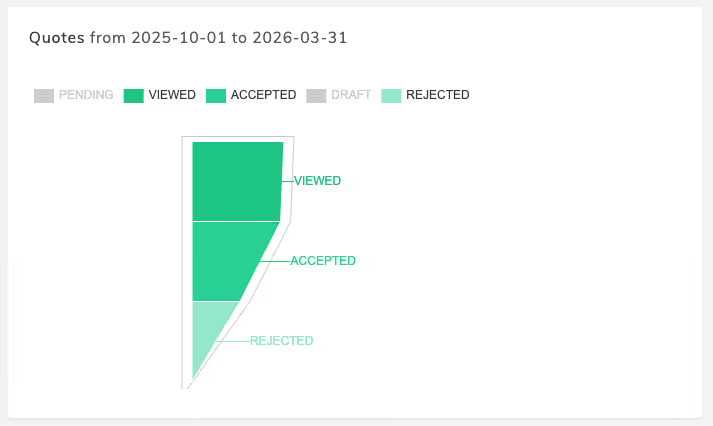
Quote pipeline from VIDA CRM (VidaTool), October 2025 to March 2026. Patient names redacted.
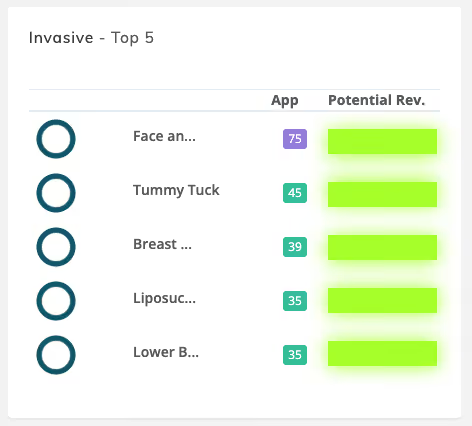
Top 5 invasive procedures by appointment volume, VIDA CRM.
Data from VIDA Wellness & Beauty Center CRM (VidaTool) and financial accounting records. Semester 1: Q4 2024 - Q2 2025. Semester 2: Q3 2025 - Q1 2026. All figures in USD.
What we built in 6 months
The moment we knew it was working
Sixty-three days after deploying the first batch of schema markup and publishing the first 12 GEO articles, we ran the monthly citation audit.
We tested 20 prompts for bariatric surgery. The same 20 we had tested in October. The same prompts that returned zero mentions of VIDA or Dr. Rodriguez.
This time, 11 of the 20 prompts named her.
"Bariatric surgery in Tijuana is one of the most competitive markets in medical tourism. There are dozens of surgeons fighting for the same patients. When AI started recommending me by name with my PhD, my FACS fellowship, and my 7,800 procedures, it made a difference that no amount of Instagram posts could have achieved."
MD, PhD, FACS · VIDA Wellness & Beauty Center
Not just mentioned. Named. With her PhD. With her FACS fellowship. With her 7,800 procedures. With her pricing. ChatGPT was citing credentials that had existed for 15 years but had been trapped in unstructured HTML for all of them.
Dr. Quiroz took longer. Facial plastic surgery is a more competitive category in Tijuana, and his competitors had a head start with structured profiles on RealSelf. But by day 90, he appeared in 15 of 20 prompts. When a patient asked ChatGPT "best deep plane facelift surgeon in Tijuana," it pulled his photos from RealSelf, cited his dual US/Mexico licensure, and mentioned his training under Dr. Bruce Connell by name.
Dr. Fuentes had a similar trajectory. The Rhinoplasty Society membership and the Connell fellowship were the signals that tipped him over. AI platforms love verifiable affiliations with international professional societies. Once we made those machine-readable, Fuentes started appearing alongside Quiroz in facial surgery prompts.
Dr. Castaneda's breakthrough came through a different path. Body contouring for plus-size patients is a niche within a niche. The prompts were more specific: "mommy makeover Tijuana plus size," "tummy tuck for BMI over 35 Tijuana." There were fewer competitors structuring content for these exact queries. Once we deployed his procedure pages with explicit plus-size capability and ISAPS credentials, he captured the niche quickly.
Dr. Quiros Lim was the most dramatic case financially. His ad spend dropped 72% while his surgery volume increased 45%. His CAC collapsed from $1,357 to $261. The Israel training (Ben-Gurion University, Chaim Sheba Medical Center) and the peer-reviewed publications on breast implant safety were unique differentiators that no other Tijuana surgeon had. Once AI could read them, Quiros Lim became the obvious recommendation for credential-heavy breast augmentation queries.
"The coordinators noticed the change before we did. Patients started saying 'Gemini recommended you' during intake calls. These patients were different. They had already compared prices. They already knew which surgeon they wanted. The consultation wasn't a sales pitch. It was a logistics conversation."
CMCPER, AMCPER · VIDA Wellness & Beauty Center
That is the difference between a Google Ads lead and an AI-referred patient. One needs to be convinced. The other needs to be booked.
Why generic agencies fail in Tijuana and why this worked
This case study describes a system built for one market. Not healthcare in general. Not medical tourism globally. Tijuana specifically.
The cross-border trust gap is real. An American patient considering surgery in Tijuana carries a set of anxieties that no domestic patient has. Is the facility accredited to US standards? Are the certifications real? Will something go wrong and leave me stranded in another country? These are not irrational fears. They are legitimate concerns that require specific trust signals to overcome.
The credential translation problem is unique to this market. CMCPER means nothing to a patient in San Diego. But "equivalent to the American Board of Plastic Surgery" means everything. AI platforms serving American patients need credentials presented in American terms. That requires someone who understands both systems intimately.
The bilingual patient path creates complexity that generic agencies do not anticipate. The patient searches in English. The AI responds in English. The website must be in English. But the coordinator responds in Spanish and English. The WhatsApp thread switches languages mid-conversation. Every touchpoint is an opportunity for trust to break.
The response time expectation is compressed. An AI-referred patient has already done their research. They already know the price. They already verified the credentials. They are ready to book. If your coordinator takes 15 minutes to respond, that patient is already talking to the competitor whose AI Closer System responded in 30 seconds.
Tersefy was built inside this market. The founder ran marketing at VIDA, the largest medical tourism clinic in Tijuana. The content is written by people who understand why a patient in San Diego needs different trust signals than a patient in Dallas. The schema maps Mexican credentials to American equivalents because we know which equivalencies matter and which do not.
That is why the results in this case study happened here and would not have happened with a different approach.
Stop paying Google for clicks when patients are asking ChatGPT for answers.
Let's find your missing revenue. $997 Cross-Border GEO Audit: 25+ prompts tested across 4 AI platforms. Creditable toward setup.
Book the $997 audit