

On June 8, 2026, at the WWDC keynote, Apple introduced Siri AI: its assistant rebuilt from zero, with a cloud layer that runs on Gemini-based models from Google, inside Apple's own servers, under a multiyear deal announced on January 12 (Apple Newsroom, June 8, 2026; Bloomberg, November 2025). It ships in beta this year, and only to recent iPhones: 15 Pro and up. For a Tijuana clinic that lives on American patients, the operational read is this: the questions your patients ask their iPhone will be answered by a generative synthesis, and your visibility in Gemini today is the best available thermometer of how you will do there. The software lands in the fall. The clock started Monday.
The 30-second summary
- Siri AI uses Gemini-based models for its cloud layer, inside Private Cloud Compute (Apple Newsroom, June 8, 2026). The summarizer and the planner, per Bloomberg, are Google's.
- It requires iPhone 15 Pro or newer. iOS 27 reaches back to the iPhone 11, but without Siri AI (Apple, June 2026). The hardware cut filters toward the premium segment, which is where your patient lives.
- Public beta in July, launch carrying a beta label on iOS 27, which ships in September. No European Union or China in the first wave: the United States debuts (Apple Newsroom; MacRumors).
- It answers with current world knowledge and cards that include information from the web: one synthesis, not ten blue links (TechCrunch, June 8, 2026).
- Your visibility in Gemini today is the best available thermometer, not a guarantee. The work window is June through August.
What Apple announced on June 8 (and what was already signed in January)
For a decade, the smartest thing Siri ever did was set the pasta timer. Apple spent two years swearing the fix was on its way. The fix arrived Monday: it wears a Google logo and a reported annual rent of one billion dollars.
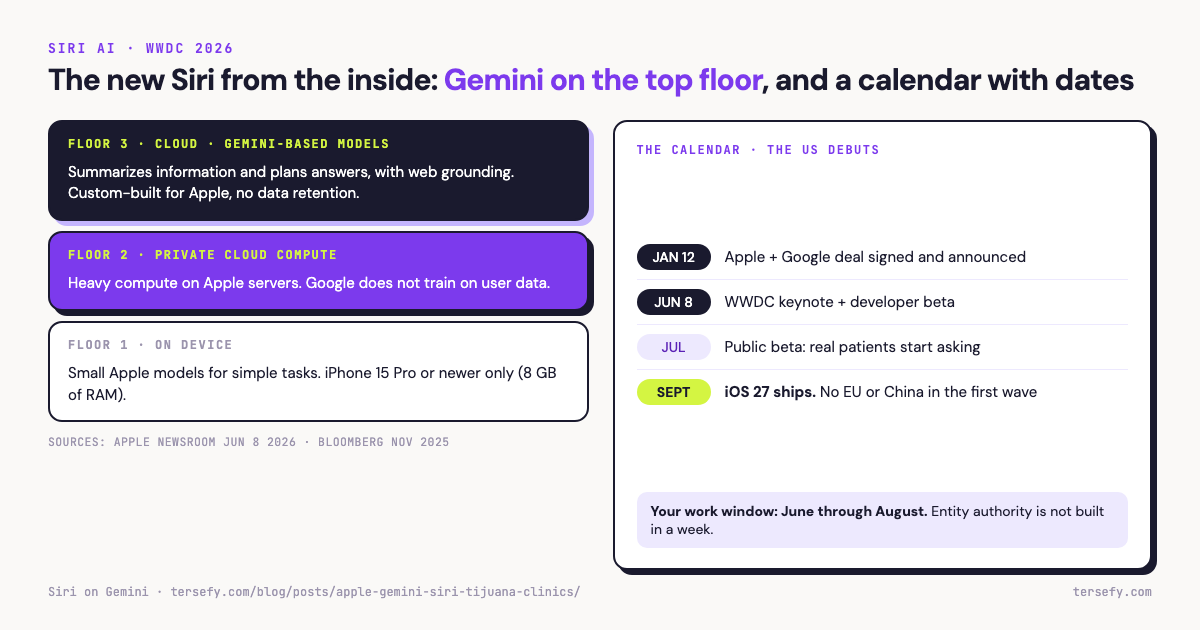
The deal was announced on January 12, 2026, in a joint statement. What the keynote added was the product: Siri AI, a new assistant with its own app, continuous conversation, Spotlight integration on macOS, and answers anchored in current world knowledge, shown in cards that include information from the web (TechCrunch, June 8, 2026). The architecture has three floors: small on-device models for the simple stuff, Private Cloud Compute for the heavy lifting without retaining data, and on top, the custom Gemini doing what matters for this article: summarizing information and planning answers, per Mark Gurman's reporting (Bloomberg, November 5, 2025).
Claims discipline before we continue: neither the billion a year nor the reported model size (1.2 trillion parameters) are figures published by Apple. They are Bloomberg reporting replicated across the tech press, high confidence, not official spec. What is official: Apple built its new generation of cloud models in collaboration with Google and the Gemini family, runs them on its own infrastructure, with no data retention and a contractual ban on Google training on Apple user data.
And the money circuit, because it explains everything else: Google pays Apple around 20 billion dollars a year to be Safari's default search engine, a figure that surfaced in the Department of Justice antitrust trial. Now Apple hands one billion back for the model behind its assistant.
Nobody at that table believes in product meritocracy. They believe in the rent of the default. You should believe the same thing.
Why this is a Tijuana clinic's business
Context first: the United States has around 150 million iPhone users, with a share that runs from 55% of the installed base to 62% of new shipments depending on the methodology (Demandsage, StatCounter, 2026), and the iPhone user spends double on tech what the Android user does, 101 versus 50 dollars a month (Demandsage, 2026).
But that is not the number that matters. Siri AI does not reach that whole installed base: it requires iPhone 15 Pro, 15 Pro Max, or any iPhone 16 onward (Apple Newsroom, June 8, 2026). iOS 27 goes down to the iPhone 11, but without Apple Intelligence or Siri AI. The real cut is not the phone's age, it is memory: Apple decided intelligent conversation starts at 8 gigabytes of RAM, which turns the phone's memory into an income proxy. For you, that is a statistical blessing. The hardware filter does for free the segmentation your media buyer charges for: Siri AI's universe is owners of recent premium iPhones, and your patient in La Jolla, Del Mar, or Newport Beach lives exactly there.
Two more facts close the pincer. One: the calendar. Public beta in July, launch on iOS 27 with a September release, and Siri AI will reach the public still labeled beta, in case two years of delay had not lowered expectations enough (MacRumors, June 8, 2026). Two: the geography. Siri AI will not be available at launch in the European Union or China (Apple Newsroom, June 8, 2026). The United States debuts. First-mover windows usually have to be imagined; this one ships with a date and a map published by Apple, and your sending market sits at the center of the map.
Verify it with your own data, not mine. Open GA4, filter US traffic by operating system and device model, and see how much of your pipeline already lives inside the eligible universe. In cross-border clinics in aesthetic specialties, that number rarely resembles the national average. It usually blows past it.
What changes underneath is the product category: Gemini stops being one more app and starts looking like decision infrastructure. If you are not yet clear on how each platform weighs its sources, how AI decides which doctor to recommend breaks the mechanics down one by one.
Where Siri will pull its answers from
Here is what is known, what can be inferred, and what nobody outside Cupertino can claim.
Confirmed at the keynote: answers are anchored in current world knowledge, and the cards display information that comes from the web (TechCrunch, June 8, 2026). There is web grounding. The answer your patient receives does not come out of a model's frozen memory: it comes from sources retrieved and synthesized in the moment.
What nobody has detailed publicly is which index feeds that grounding. Two scenarios. If the custom Gemini drinks from Google's stack, everything that already weighs in Gemini weighs double: Knowledge Graph, Google Business Profile, reviews, schema. The generalist SEO press has spent the months since January calling the Business Profile your résumé in front of Siri, and for local queries that is a reasonable read. If instead the grounding runs on Apple's own index, the one feeding Spotlight and crawled by Applebot, structured content and a consistent entity are still the input; only the collector changes.
The operational point: you do not need to solve the mystery to act, because both scenarios converge on the same job. Be the citable source. Direct answers, data with visible source and date, a verifiable medical entity with clean schema, and zero blocks on the relevant crawlers in your robots.txt (googlebot and Applebot at minimum). Optimizing under uncertainty sounds impossible until you notice both branches of the tree ask for exactly the same thing.
The questions that change owners
The query format changes with the medium. In a search box, the patient types "plastic surgeon tijuana". To a conversational assistant, they ask something else: is it actually safe to get a mommy makeover in Tijuana, how do I verify a surgeon in Mexico is board certified, what happens if something goes wrong after surgery abroad. Longer queries, in natural language, loaded with the variable that actually decides the cross-border sale: fear.
And the answer is no longer a results page where you show up in position four. It is a synthesis. One. Whoever is inside that answer exists; whoever is not buys ads to pretend they exist. The reference academic research found that pages with citations, statistics, and verifiable sources increase their visibility in generated answers by up to 40%, with results that vary by domain (Aggarwal et al., Princeton, KDD 2024). For us that is not theory: it is the exact mechanism by which trust content, the kind that answers fear with documents, board credentials, and complication protocols, beats price content.
A dated market note: since the January announcement, generalist SEO agencies in the United States have been publishing about Siri and local business. In medical marketing, and specifically in cross-border medical tourism, as of June 11, 2026, nobody has landed the topic. That gap is the window. It does not last months.
What do you do this week? Five moves
Mark each move as you put it in motion: 0/5 in motion
Open Gemini and ask it your patients' ten real questions, in English, the way someone in San Diego would. Document three things: whether you show up, who does, and which sources it cites. That dated record is your best thermometer of what is coming, and measuring it costs zero. The full mechanics of the test are in how to check if ChatGPT can find your clinic: same play, different platform.
The surgeon and the clinic must exist as verifiable entities: Physician and MedicalClinic schema, specialist board credentials visible and checkable, sameAs pointing to consistent profiles, identical NAP everywhere. A model does not recommend what it cannot verify.
For local queries, Google's ecosystem is the most likely road into Gemini's grounding. Complete, correct categories, real photos, answered reviews, exact hours. It is the most boring chore on the list and the highest expected return. That is how most things that work tend to look.
Every parent query decomposes into sub-questions, and the cross-border patient's sub-questions are about safety: certifications, what happens if there are complications, remote follow-up, hospital accreditations. One page per sub-question, with a direct 40-to-60-word answer under the H2, data with source and date, and FAQPage schema. Before July 31.
Put AI visibility tracking into your monthly report (mentions in Gemini, ChatGPT, and Perplexity), segment GA4 by iOS and device model, and schedule a visible update of your core content for the week iOS 27 ships publicly. Freshness with a visible date is a signal, not cosmetics.
What we don't know yet
Four open unknowns, so nobody sells you certainty that does not exist. One: the final attribution format. Apple showed cards with information from the web, but not the production detail of how it cites or links sources. Two: the exact grounding index, as covered above. Three: the tech press reports iOS 27 will allow switching the default AI model; if confirmed, multi-model optimization stays alive, although the default captures the volume and the default is the Gemini layer. Four: real adoption, because the developer beta shipped Monday and usage numbers do not exist. Any traffic projection you see this week is smoke with charts. And anyone selling you certainty on these four points does not have inside information: they have a retainer to justify. What you can do is stand where every scenario pays, which is exactly what the previous section describes.
Quick answers
What is Siri AI?
The assistant Apple rebuilt and introduced on June 8, 2026: conversational, with its own app, and answers anchored in current world knowledge. Its cloud layer runs on Gemini-based models inside Apple's servers.
Which iPhones get Siri AI?
Only iPhone 15 Pro, 15 Pro Max, and any iPhone 16 or newer. iOS 27 reaches back to the iPhone 11, but without Apple Intelligence or Siri AI, per Apple's June 2026 requirements.
When does Siri AI reach patients?
Developer beta since June 8, 2026, public beta in July, and a public launch carrying a beta label on iOS 27, which ships in September 2026.
Does Siri use Google now?
For summarizing and planning answers, yes: Gemini-based models, custom-built for Apple, running in Private Cloud Compute with no data retention. Apple keeps its own models on the device.
What changes for a clinic with US patients?
Patient questions on recent iPhones will be answered by a generative synthesis with web grounding: one answer, not a list of links. Being inside that answer is the new visibility game.
How do I know if Gemini already recommends my clinic?
Ask Gemini your patients' ten real questions today, in English, and document who shows up and what it cites. That dated record is your thermometer before Siri arrives.
Does the Google Business Profile matter for Siri?
For local queries, Google's ecosystem is the most likely path into Gemini's grounding. A complete, consistent profile is the lowest-cost bet on the entire list.
What is the real window to act?
June through August 2026. iOS 27 ships publicly in September, the United States is in the first launch wave, and entity authority is not built in a week.
On June 8, Apple bought Siri a brain from Google. Between today and the September release, it gets decided which clinics live inside that brain and which ones ask the competition for permission to exist. Doctor: if you want your Gemini baseline documented before the public launch, we run it at Tersefy this week: book the $997 Audit. And if you want to see where you stand first at no cost, start with the Free AI Visibility Scorecard.
Related articles
- The Complete GEO Playbook for Medical Tourism in Tijuana
- What is GEO? The Medical Tourism Clinic's Guide
- How AI Decides Which Clinic to Recommend
- Doctor Profiles AI Can Trust: Physician Schema for Tijuana Surgeons
- Why Google Ads Buys Fewer Patients in 2026
Sources
- Apple Newsroom, "Apple introduces Siri AI, a profoundly more capable and personal assistant", June 8, 2026. apple.com/newsroom
- Apple, WWDC 2026 Keynote, June 8, 2026. youtube.com
- MacRumors, "Apple Says New Siri is Compatible With These iPhones, iPads, and Macs", June 8, 2026. macrumors.com
- TechCrunch, "Apple's long-awaited AI Siri overhaul is finally here", June 8, 2026. techcrunch.com
- TechCrunch, "WWDC 2026: Everything announced on Siri AI, iOS 27, Apple Intelligence and more", June 9, 2026. techcrunch.com
- CNBC, WWDC 2026 live coverage, June 8, 2026. cnbc.com
- Bloomberg (Mark Gurman), "Apple Plans to Use 1.2 Trillion Parameter Google Gemini Model to Power New Siri", November 5, 2025. bloomberg.com
- 9to5Mac, "Apple nears $1 billion Google deal for custom Gemini model to power Siri", November 5, 2025. 9to5mac.com
- StatCounter Global Stats, iOS version market share, United States, accessed June 9, 2026. gs.statcounter.com
- Demandsage, "iPhone vs Android User Market Share", 2026. demandsage.com
- Aggarwal, P. et al., "GEO: Generative Engine Optimization", Princeton University, KDD 2024. arxiv.org