

Generative Engine Optimization is the practice of structuring your clinic's digital presence so AI systems can more easily recognize, retrieve, and reference your doctors when patients ask for recommendations.
I could leave it at that definition and let you Google the rest. But the reason I'm writing this is because I spent the better part of a year figuring out what GEO actually means when you're the one implementing it. Not from a blog post. Not from a conference talk. From inside a clinic in Tijuana where the leads were drying up and nobody could tell me why.
If your organic numbers have been slipping lately, not dramatically, more like a faucet that's slowly losing pressure, this may be one of the reasons.
What happened to our leads
I ran marketing and sales for one of the largest medical tourism clinics in Tijuana. Multiple specialties, multiple doctors, significant ad spend, years of SEO investment. By every traditional metric we were in good shape.
Then the numbers started moving in the wrong direction. Not a collapse. Just a consistent downward drift in organic inquiries that nobody on the team could explain. Rankings hadn't changed much. Reviews were still strong. Content was still going out. But fewer patients were coming through the door from organic channels.
It took us a while to figure out what was going on. The answer, once we found it, was embarrassingly simple: patients had changed where they ask for recommendations. They weren't typing "best bariatric surgeon in Tijuana" into Google anymore. They were asking ChatGPT. And ChatGPT had no idea the clinic's doctors existed.
That realization sent me down a rabbit hole that eventually led to everything we now do under the name GEO.
The scale of the shift
I'm not going to dump a wall of statistics on you. But there are a few numbers worth sitting with because they explain why this isn't a temporary trend.
BrightEdge's 2025 analysis shows AI search is the fastest-growing referral channel they've ever tracked, with double-digit month-over-month growth. Healthcare AI Overviews now appear in 87% of medical queries, up from 72% in 2024. Even with AI still at under 1% of total referral traffic, the trajectory is hard to ignore.
Capgemini's 2025 Consumer Trends Report (12,000 consumers across 12 countries) found 58% had replaced traditional search engines with Gen AI tools for product and service recommendations, up from 25% in 2023. KFF reported in March 2026 that 1 in 3 US adults now use AI chatbots for health-related information. For cross-border medical tourism, where patients have extra anxiety about safety and credentials, the number is likely higher.
Meanwhile, Google watched all this happen and responded by putting AI-generated answers (what they call AI Overviews) at the top of search results in over 200 countries. So even patients who still use Google are now reading an AI-generated answer before they see a single organic link. The impact is already measurable: Seer Interactive's analysis found that queries with AI Overviews saw 61% lower organic CTR and 68% lower paid CTR, while businesses cited inside AI Overviews saw better click-through rates than those not cited. Being cited by AI is becoming more valuable than ranking below it.
For Tijuana specifically, the Baja Health Cluster estimates over one million medical and wellness visitors arrive in the region every year. Most of them are Americans who live 20 minutes away in San Diego. These are people who ask their phone a question while sitting on the couch. And increasingly, that question goes to an AI model, not a search engine.
If a growing share of your potential patients are asking AI for recommendations, and AI doesn't know your clinic exists, you have a leak in your pipeline that no amount of traditional SEO will fix.
So what is GEO, technically
The term actually comes from a 2024 research paper out of Princeton, Georgia Tech, and IIT Delhi, published at KDD, one of the top conferences in data science. They coined the term "Generative Engine Optimization" and built a benchmark to test which content strategies actually improve visibility in AI-generated responses.
In their benchmark, content with direct quotations improved citation rates by up to 41%. Content with inline statistics improved by up to 32.6%. Content citing authoritative sources improved by up to 28%. And overall, their GEO strategies boosted visibility by up to 40%.
Those findings suggest that AI systems respond better to content that is factual, sourced, and structured for extraction. Which is what 90% of clinic websites are not. Most clinic websites say "world-class care" and "experienced team" and "state-of-the-art facilities." None of that gives AI anything to cite.
GEO, in practice, means rebuilding your digital presence so that every important fact about your doctors, your procedures, your credentials, and your outcomes is structured in a way that AI can find it, verify it, and use it in a response.
Some people call it AEO (Answer Engine Optimization). Others call it LLMO. The label matters less than the principle: if you want to be the answer AI gives to a patient, you have to give AI something worth citing. But the "GEO and AEO are just SEO with fresh paint" line you hear at marketing conferences is wrong in ways that cost clinics money, so it's worth unpacking the differences properly.
How GEO differs from SEO
If you've been doing SEO, keep doing it. GEO doesn't replace SEO. It sits on top of it.
But the mechanics are different and it's worth understanding why.
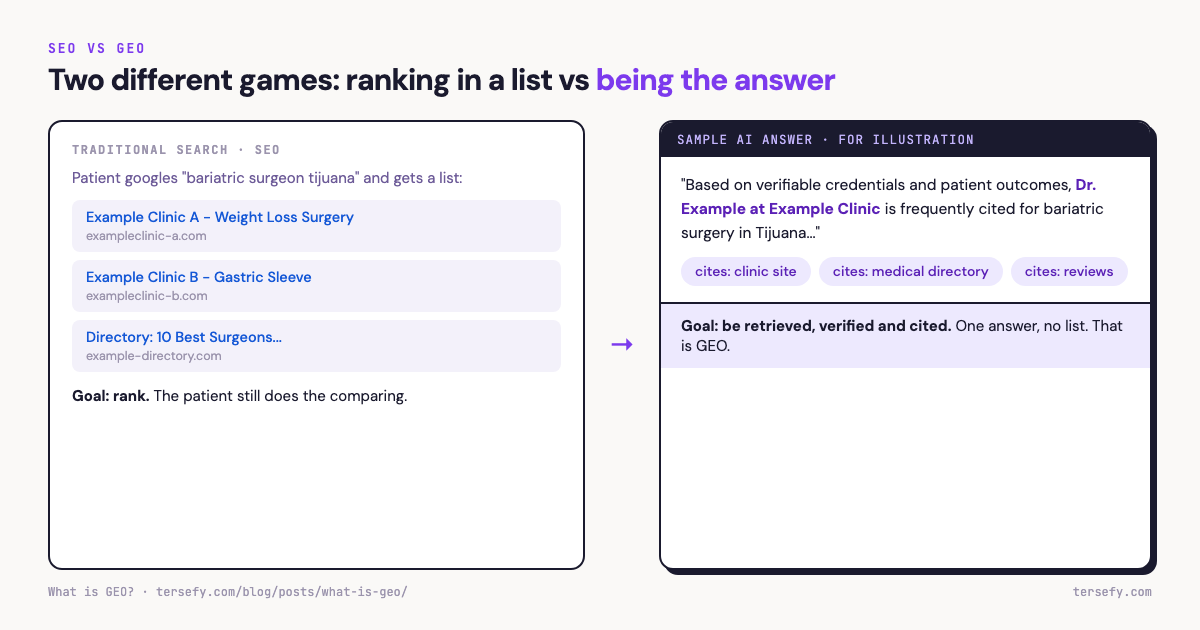
SEO is a competition for position on a list. You optimize your page, you build links, you target keywords, and you try to get Google to rank you higher than the clinic down the street. The patient sees 10 links and clicks one. Your job is to be in those top 10. Position one gets roughly 27% of clicks. Position ten gets about 2.5%. Everything below the fold is effectively invisible.
GEO is a competition to be the answer itself. There's no list. AI pulls from the information available to it, weighs what appears most relevant and credible, and generates a response. Sometimes it mentions three clinics. Sometimes it mentions one. Sometimes it mentions none. There are no rankings to track. There's just: did AI cite you, or didn't it?
In SEO, a patient has to click your link and visit your site to learn anything about you. In GEO, the patient learns about you directly from the AI's response. Your name, your credentials, your pricing, your location. All delivered before they ever visit a website. SEO tries to win the click. GEO tries to win the citation inside the answer. Those are related disciplines, but they are not the same job.
| Traditional SEO | GEO (Generative Engine Optimization) |
|---|---|
| Optimizes for Google rankings | Optimizes for AI citations |
| Patient sees list of 10 links | Patient sees one synthesized answer |
| Patient clicks a link | Patient reads the answer directly |
| Backlinks, keywords, page speed | Schema, entities, factual density |
| Trust built by backlinks from other sites | Trust built by entity verification and structured credentials |
| Pricing has minimal impact on rankings | Pricing visibility is critical for AI comparison |
| Best-optimized page wins | Most extractable, authoritative content wins |
| Measure rankings and CTR | Measure mentions, citations, AI visibility |
What AEO adds to the picture
AEO, or Answer Engine Optimization, sits between SEO and GEO. It optimizes specifically for being the featured answer in Google's AI Overviews, Bing's AI answers, and similar answer-box formats.
AEO is relevant because it represents the transition zone. Google is increasingly replacing traditional search results with AI-generated answers at the top of the results page. These AI Overviews absorb the click that used to go to position one. If your clinic is cited in the AI Overview, you capture the patient's attention before they ever scroll to the organic results.
AEO requires many of the same signals as GEO: structured data, answer-first content, entity clarity, and cross-platform verification. But AEO is primarily a Google phenomenon, while GEO extends to every AI platform where patients ask questions.
The point is this: AEO and GEO are not interchangeable with SEO. They are complementary disciplines that require different infrastructure, different content strategies, and different measurement frameworks.
What we've observed about AI visibility signals
Nobody outside OpenAI, Google, or Anthropic knows exactly how these models decide what to cite. The Princeton paper gave us a framework. Everything else comes from practitioners testing, observing, and comparing notes.
What I can tell you is what we've seen after months of rebuilding the digital presence of multiple doctors across different specialties. These patterns have been consistent enough that we now treat them as our operating framework.
Extractable content. AI needs statements it can pull directly into a response. "Dr. Rodriguez is a board-certified bariatric surgeon with a PhD, FACS fellowship, dual US-Mexico licensure, and over 7,800 procedures" is something AI can work with. "Our experienced team provides world-class care" is not. Most clinic websites are full of the second kind and empty of the first.
Schema markup. This is machine-readable code embedded in your website that tells AI what each piece of content actually means. Physician schema, MedicalOrganization, MedicalProcedure, FAQPage. Without it, the content may still be usable, but it's less clearly labeled for machines. With it, every credential, every procedure, every FAQ answer is labeled and organized for extraction. And the depth matters: individual procedure pages, each with its own URL, its own pricing, and its own MedicalProcedure schema linking to the performing surgeon, are how AI knows that a specific doctor performs a specific procedure at a specific price in a specific city.
Review specificity. Not just volume and rating, though those matter. What seems to really move the needle is the content of the reviews. "Dr. Quiroz performed my deep plane facelift at VIDA Wellness & Beauty Center. Natural results, minimal bruising, flew in from San Diego." That gives AI several useful signals. "Great doctor, 5 stars" gives it far less to work with. We cover exactly how to get patient reviews AI can actually use in a separate guide.
Entity recognition. AI needs to understand your doctor as a distinct person tied to specific procedures, credentials, and locations. Not just a name on a staff page. A recognizable professional entity with a consistent profile across the web. Without their own website, their own Google Business profile, and consistent directory listings, the AI has very little to build from.
Cross-platform consistency. AI checks multiple sources. If your doctor's credentials are different on their personal site, Healthgrades, Doctoralia, and Google Business, the AI can't build a reliable profile. Every platform needs to say the same thing.
Pricing visibility. This is the single largest difference between SEO and GEO for medical clinics. In SEO, hiding your pricing behind "Call for quote" had minimal impact on your rankings. In GEO, it severely limits your visibility. When a patient asks "How much does a gastric sleeve cost in Tijuana?", AI strongly favors clinics with pricing visible on their websites. If your pricing is hidden, you make it much harder for AI to compare you on cost-sensitive prompts. In many medical tourism queries, that lowers your chances of being cited. AI cannot recommend what it cannot compare.
Freshness. Active publishing signals an active practice. Stale content signals an inactive one. AI appears to weight recently published material more heavily, especially for time-sensitive queries.
These are our observations, not gospel. But they've held up across every implementation we've done.
The credential translation problem
AI platforms serving American patients need Mexican medical credentials presented in American terms. This is a challenge unique to the Tijuana medical tourism market that generic agencies do not understand.
When a patient in San Diego asks ChatGPT for a board-certified plastic surgeon, the AI needs to verify credentials it can understand. Here is the mapping that matters:
SEO never required this translation. A Google search for "board certified plastic surgeon Tijuana" would return your page if it ranked for those keywords, regardless of whether Google understood the credential equivalency.
GEO requires it. When AI constructs a recommendation, it evaluates credentials. If it cannot verify that CMCPER is a legitimate board certification equivalent, it may decline to recommend a surgeon it cannot validate. The solution is explicit credential mapping: structured data and visible content that translates Mexican medical credentials into American equivalents that both AI and American patients can understand.
This is not something a generic SEO agency in Los Angeles or Miami will think about. It requires someone who understands the Mexican medical credentialing system, the American patient's frame of reference, and the technical infrastructure needed to make AI bridge the gap.
Why this matters more in Tijuana than most places
Tijuana has something most medical tourism destinations don't: a massive gap between the quality of care and the quality of digital infrastructure.
The medical talent in Tijuana is stronger than its digital footprint suggests. The Baja Health Cluster calls Tijuana the number one medical destination in Mexico for international patients. Over one million visitors a year. Procedures cost 40-70% less than the US. Many doctors trained in American residency programs. The city is 20 minutes from San Diego. Patients can get surgery and recover across the border from home.
All of that is exactly the kind of factual, structured, verifiable information that AI loves to work with. The raw material for AI visibility is already there.
The problem is that almost nobody has organized it. Most clinic websites in Tijuana are brochure sites. No schema. No individual doctor profiles. Generic reviews. Published research disconnected from current practice. Academic credentials buried in PDFs that no AI can read.
And the patient journey has already moved. Five years ago, a patient in San Diego considering bariatric surgery in Tijuana would Google "best bariatric surgeon Tijuana," click through five or six websites, compare prices, read reviews, and eventually call a coordinator. Today, that same patient opens ChatGPT and asks: "Who is the safest FACS-certified bariatric surgeon in Tijuana with pricing under $5,000?" The AI responds with a direct recommendation. If your surgeon is named, the patient contacts your coordinator. If your surgeon is not named, the patient contacts the surgeon who was named. There is no page two. There is no "let me also check this other clinic." The AI gives an answer, and the patient acts on it. Coordinators at clinics in Tijuana are already reporting patients who say "ChatGPT recommended you" during intake calls.
The gap between what Tijuana surgeons have accomplished and what AI can see about them is probably the widest in any major medical tourism market. That's the bad news. The good news is that clinics that fix it early may have an outsized advantage. We unpack the surgeon-facing version of this in AI visibility for Tijuana surgeons.
What the implementation looks like
When we built this out for doctors at VIDA Wellness & Beauty Center, it wasn't a weekend project. There's no shortcut and no tool that automates it. It's layered work that compounds over time.
The foundation is entity building. Personal websites for each doctor with complete schema markup. Individual Google Business profiles. Consistent information across every directory (RealSelf, Healthgrades, Doctoralia). Published research linked to current practice. In our experience, this usually takes about two weeks, and it makes everything else work better.
On top of that goes content architecture. FAQ hubs with the answer first and context second. Procedure pages with real pricing, real recovery timelines, real outcomes data. Blog posts that include statistics and cite their sources. Content that exists to be useful, not to fill a marketing calendar.
Then reputation infrastructure. A review process that guides patients to mention specific details. Consistent velocity. Active management across platforms. This never stops.
And monitoring. We test 20+ prompts per doctor across ChatGPT, Gemini, Claude, and Perplexity every month. We document what changed. We adjust. Most people skip this part, which is why most people can't tell you whether their GEO work is actually doing anything. The number that matters is citation share: the percentage of relevant AI prompts that mention your clinic by name. It is the GEO equivalent of tracking your Google rankings.
What changed for us
We started this work in late 2025. Within 60 days of implementation, we began seeing previously invisible doctors appear in our prompt testing across AI platforms. Not generically. With their credentials, procedure counts, pricing, and direct links to their sites.
I wrote about one case in detail: two facelift surgeons at VIDA Wellness & Beauty Center who trained under Dr. Bruce Connell, a surgeon widely credited with pioneering the deep plane facelift technique. Between them they do over 40 deep plane facelifts a month. And ChatGPT had never heard of either of them. That article walks through exactly what was broken and how we fixed it.
The patterns held across every specialty we worked on, including bariatric surgery and plastic surgery. Structured data, complete entity profiles, detailed reviews: those clinics showed up. Everyone else was invisible. It wasn't luck. It was architecture.
The financial side is documented in the VIDA case study. Before GEO implementation, all five surgeons had zero presence in AI recommendations, despite credentials like a PhD from UT Houston, FACS fellowship, and 7,800+ procedures. After six months of GEO work, citation share climbed from 0% at baseline to as high as 85% on the lead surgeon. Ad spend dropped 50% ($492,187 to $245,560 per semester) while surgeries increased 13% (516 to 584). Average cost per acquisition dropped 57% from $954 to $420 across four plastic surgeons. One surgeon, Dr. Enrique Quiros Lim, saw his cost per acquisition collapse from $1,357 to $261 while his surgery volume increased 44.8%.
An SEO campaign did not produce these results. SEO was already running. The clinic had strong Google rankings, active Instagram, hundreds of five-star reviews, and $40,000+ per month in Google Ads. SEO was doing its job. But SEO could not make ChatGPT recommend a surgeon by name. That required a fundamentally different approach.
The response time amplification effect
There is another dimension where GEO and SEO diverge completely: what happens after the patient finds you.
In the SEO model, a patient clicks through to your website, browses your content, reads reviews, and eventually fills out a contact form or calls your coordinator. The time between discovery and contact can be hours or days. The patient may visit multiple websites before deciding.
In the GEO model, the patient gets a direct recommendation from AI and is ready to book immediately. They have already compared prices, already verified credentials, already read reviews, all inside the AI conversation. When they contact your coordinator, they are not browsing. They are buying.
This means response time becomes critical. If your coordinator takes 15 minutes to respond to a GEO-referred patient, that patient may already be talking to the competitor whose automated system responded in 30 seconds. The tolerance for delay is dramatically lower because the patient has already made their decision. They just need logistics.
SEO never required you to think about response time as a competitive advantage. GEO does. And the clinics that combine AI visibility with AI-powered response systems will capture a disproportionate share of these high-intent patients.
The compounding advantage
The final critical difference between SEO and GEO is how results compound over time.
In SEO, rankings are competitive and volatile. You rank for a keyword, a competitor publishes better content, and your ranking drops. Google updates its algorithm, and positions shift. SEO requires continuous investment to maintain position.
In GEO, entity architecture compounds. Every article you publish, every review that mentions your surgeon by name, every directory listing that confirms your credentials, every structured data deployment that connects your surgeon to their procedures, all of it strengthens the entity graph that AI uses to construct recommendations.
The first clinic in a specialty to build this entity architecture gains a structural advantage that is difficult for competitors to replicate quickly. AI models learn from accumulated, cross-referenced data. A surgeon who has been consistently mentioned across multiple authoritative sources for six months has a citation advantage over a surgeon who starts building their entity architecture today.
This is why the "GEO is just SEO" dismissal is so dangerous. Every month you wait to build AI visibility infrastructure is a month your competitors use to build an entity advantage that compounds. The cost of waiting is not zero. It is the accumulated citation share your competitor gains while you are still debating whether GEO is real.
What your current agency is probably not doing
If you have a marketing agency managing your clinic's digital presence, ask them these five questions:
What does ChatGPT say about my clinic? If they do not know the answer, they are not doing GEO. This is the most basic audit: type your specialty and city into ChatGPT and see what comes back. If your agency has never tested this, they are optimizing for a platform your patients are no longer using as their primary discovery channel.
Do we have Physician schema on our doctor profile pages? Not Organization schema. Not basic website schema. Physician schema (schema.org/Physician) with credentials, affiliations, procedures, pricing, and facility connections. This is the structured data that AI models use to verify and cite your surgeons. If your agency does not know what Physician schema is, they are doing SEO, not GEO.
Do we have individual procedure pages with visible pricing and MedicalProcedure schema? Not a service page listing twelve procedures. Individual pages, each with its own URL, its own content, its own pricing, and its own MedicalProcedure schema linking to the performing surgeon. Without this structure, AI has no way to construct a specific recommendation.
Do we have an llms.txt file? This is an emerging, optional signal worth testing, not a foundational requirement. Some marketers use it to point AI systems toward authoritative pages, but there is still limited evidence that major AI platforms rely on it in any meaningful way. If your agency talks about llms.txt but ignores structured data, entity consistency, and visible pricing, they are focusing on the wrong thing.
What is our citation share? If your agency reports website traffic, click-through rates, and impression counts but has no data on citation share, they are measuring SEO metrics, not GEO metrics.
None of these questions are trick questions. They are basic requirements for AI visibility in 2026. If your agency cannot answer them, it does not mean they are bad at SEO. It means they are not doing GEO. And those are different things.
What to do right now
Open ChatGPT. Type "Best [your specialty] in Tijuana." See what happens. Try Gemini. Try Perplexity. Check Google and look at the AI Overview above the regular results.
If you're there, check that the information is accurate and complete. If you're not, you just saw the problem with your own eyes. And now you have a framework for understanding what needs to change.
Separate your GEO budget from your SEO budget. They are different disciplines. Your SEO agency can continue managing your Google rankings. Your GEO work requires entity architecture, schema markup, citation-focused content, and AI response systems that most SEO agencies are not equipped to deliver.
Start with entity architecture. Before you publish another blog post or run another Google Ad, make sure your surgeon profiles have Physician schema, your procedure pages have MedicalProcedure schema with pricing, and your credentials are mapped to their American equivalents in structured data. Our guide to structuring doctor profiles for AI trust walks through exactly what this means in practice.
Publish your pricing. This is the single highest-impact change you can make for AI visibility. Replace "Call for quote" with a visible price range on every procedure page.
Measure citation share. Stop measuring website traffic as your primary KPI. Start measuring how many AI prompts mention your clinic by name. That is the metric that correlates with the new patient behavior.
Gartner forecast in February 2024 that traditional search volume would drop 25% by the end of 2026. Observed data through mid-2025 is more modest - BrightEdge reports AI search currently accounts for under 1% of total referral traffic, though it's the fastest-growing referral channel they've ever tracked. The clinics building AI visibility now may benefit from a compounding advantage. The ones that wait may find it harder to dislodge practices that established visibility earlier.
Most clinics in Tijuana haven't started. That's the window. It won't last, but right now it's wide open. For the doctor-side version of this same problem, see AI visibility for Tijuana surgeons. For the full framework, see our complete GEO playbook.
You have two options.
You can spend the next six months trying to reverse-engineer how ChatGPT extracts entity data, mapping your own schema, and building AI response systems while your competitors steal your citation share.
Or you can let the insiders do it. The $997 Cross-Border GEO Audit tests 25+ real patient prompts across ChatGPT, Gemini, Perplexity, and Google AI Overviews to see exactly what AI says about your clinic today. Delivered in 3 business days. Creditable toward setup.
Quick answers
What is Generative Engine Optimization in plain terms?
GEO is the practice of structuring your clinic's digital presence so AI systems can recognize, retrieve, and reference your doctors when patients ask for recommendations. It sits on top of SEO, not replacing it.
Where did the term GEO originate?
A 2024 Princeton, Georgia Tech, and IIT Delhi research paper published at KDD. Their benchmark showed direct quotations improved citation rates up to 41%, inline statistics up to 32.6%, and overall GEO strategies boosted AI visibility by up to 40%.
How does GEO differ from traditional SEO?
SEO competes for position on a list of links. GEO competes to be the answer itself. There are no rankings to track in GEO, just whether AI cited your practice, your doctor, or skipped you entirely.
What percentage of consumers now use AI instead of traditional search?
Capgemini's 2025 Consumer Trends Report of 12,000 consumers across 12 countries found 58% had replaced traditional search with Gen AI tools for recommendations, up from 25% in 2023. BrightEdge reports healthcare AI Overviews on 87% of medical queries.
What signals appear to drive AI visibility?
Extractable content, schema markup like Physician and MedicalProcedure, review specificity, entity recognition tied to distinct doctor profiles, cross-platform consistency across Healthgrades, Doctoralia, and Google Business, visible pricing, plus content freshness on recently updated pages.
How long does GEO implementation typically take?
Foundation entity building usually takes about two weeks. Within 60 days of full implementation, previously invisible VIDA doctors began appearing in prompt tests across ChatGPT, Gemini, Claude, and Perplexity with credentials, procedure counts, and pricing.
Can my current SEO agency do GEO?
Ask them five questions: What does ChatGPT say about your clinic? Do you have Physician schema? Do you have individual procedure pages with MedicalProcedure schema? Do you have an llms.txt file? What is your citation share? If they cannot answer these, they are doing SEO, not GEO.
What is citation share?
Citation share measures the percentage of relevant AI prompts that mention your clinic by name. It is the GEO equivalent of tracking Google rankings. Tersefy tests 20+ prompts monthly across ChatGPT, Gemini, Perplexity, and Google AI Overviews.
Does pricing visibility really matter for AI?
Yes. When a patient asks how much a gastric sleeve costs in Tijuana, AI can only recommend clinics with visible pricing. Clinics that hide pricing behind Call for quote are excluded from the answer entirely. This is the single highest-impact change most clinics can make.
What credentials does AI verify for surgeons in Tijuana?
AI platforms look for board certifications (CMCPER, CONACEM), professional society memberships (AMCPER, ASAPS, ISAPS), facility accreditations (AAAASF), education, procedure volume, pricing, and cross-platform consistency. Mexican credentials must be mapped to their American equivalents for US patient queries.
Related articles
- How AI Decides Which Clinic to Recommend (And Why It's Probably Not Yours)
- Why Your Clinic Has 500 Five-Star Reviews and ChatGPT Still Doesn't Know You Exist
- Why Your Tijuana Clinic's Traffic Dropped, Even If Your SEO Reports Still Look Good
- The Complete GEO Playbook for Medical Tourism Clinics in Tijuana
- How to Structure a Doctor Profile So AI Can Trust It: A Tijuana Clinic's Guide to Physician Entity Optimization
- The VIDA Case Study: How 4 Invisible Surgeons Became AI-Visible in 6 Months
Version history(3 versions)
- v1.22026-07-13Consolidated the GEO/AEO vs SEO explainer into this guide: AEO, credential translation, the five agency questions, pricing visibility, response time, compounding, and the VIDA financial results now live here.
- v1.12026-04-12Added Princeton, Georgia Tech, and IIT Delhi 2024 GEO benchmark citations with direct quotation uplift percentages.
- v1.02026-03-19Initial publication.