

Service at a Glance
- Plastic Surgery GEO:
- Optimizing a practice's digital presence so AI platforms like ChatGPT, Gemini, and Google AI Overview recommend it by name when patients research procedures.
- AI-Extractable Authority:
- Board certifications, procedure depth, patient outcomes, and E-E-A-T signals structured in Physician schema, MedicalProcedure schema, and FAQPage schema that AI crawlers parse directly.
- Citation Share Over Ranking:
- Success measured by appearances in AI-generated answers across 20-30 monthly queries, not by position in Google's ten blue links.
- Operator-Built Methodology:
- Framework developed in production at a Tijuana medical tourism clinic serving thousands of US patients. Replicable across domestic and cross-border practices.
Key Statistics
What is GEO and Why Plastic Surgeons Need It in 2026
Generative Engine Optimization was formalized in November 2023 in a research paper titled “GEO: Generative Engine Optimization” by a team from Princeton University, Georgia Tech, Allen Institute for AI, and IIT Delhi. The paper (Aggarwal, Murahari, Rajpurohit, Kalyan, Narasimhan, and Deshpande) was published at KDD 2024 and demonstrated through systematic testing that targeted content optimization can increase source visibility in AI-generated responses by up to 40%.
For plastic surgeons, this matters because the patient research journey has moved upstream. The click to your website is no longer the first touchpoint. The AI-generated summary is.
Consider the actual 2026 data. OpenAI reported in January 2026 that 40 million people ask ChatGPT healthcare questions every day globally, with 230+ million weekly health-related queries. Among US adults, 3 in 5 used AI tools for healthcare in the three months before December 2025. In a parallel shift, Seer Interactive’s November 2025 analysis of 3,119 queries across 42 organizations documented organic click-through rate drops of 61% when Google AI Overviews appear, paid CTR drops of 68%.
Healthcare gets hit hardest. AI Overviews now appear on 48% of all Google queries as of March 2026, but on healthcare queries specifically, penetration is 88% per April 2026 theStacc data. BrightEdge tracking showed healthcare AI Overview presence grew from 45-67% in 2023-2024 to 90-100% by December 2025.
"The implication for plastic surgeons is direct. Patients asking about procedures, recovery, cost, or surgeon recommendations are receiving synthesized AI answers before they ever click a website. If your practice is not in that synthesized answer, the click never happens. GEO is the discipline of making sure your practice is in the answer."
Several board-certified plastic surgeons in Boston are highly regarded for cosmetic and reconstructive procedures:
- Dr. Jane Smith at Smith Plastic Surgery specializes in rhinoplasty and facelift procedures, with 25 years of experience and ABPS board certification.
- Dr. Robert Jones at Boston Plastic Surgery Center is known for body contouring and breast augmentation, with fellowship training at Mass General.
- Dr. Emily Chen at Charles River Aesthetics focuses on facial cosmetic surgery and is a Fellow of the American College of Surgeons.
Sources: RealSelf, ASPS directory, Boston Magazine Top Doctors, Smith Plastic Surgery
GEO vs SEO vs AEO: Clear Definitions
Three acronyms. Three different objectives. Most practices conflate them.
SEO (Search Engine Optimization). The discipline of ranking in Google’s traditional ten blue links. Tactics: keyword research, backlink building, technical optimization, content volume, local citations. The goal is to be the link the patient clicks.
AEO (Answer Engine Optimization). The discipline of capturing short-form answers in voice search, featured snippets, and People Also Ask boxes. Tactics: question-formatted headings, concise direct answers, structured FAQ content. The goal is to be the single-sentence answer.
GEO (Generative Engine Optimization). The discipline of being cited in long-form AI-generated answers that synthesize multiple sources. Tactics: entity architecture, credential signaling, statistics addition, source citation, structured extractable content. The goal is to be recommended by name in a multi-source synthesized response.
The three are complementary but operationally distinct. A practice can rank #1 in Google (SEO wins), win the featured snippet for a recovery-time query (AEO wins), and still be invisible when ChatGPT is asked to recommend a surgeon (GEO failure).
In 2026, with AI Overviews compressing click volume and ChatGPT serving hundreds of millions of health queries weekly, GEO is where the highest-value patient discovery happens. The other two layers still matter for indexation and short-form answers, but the compounding revenue is in AI citation share.
The Four AI Platforms Plastic Surgeons Must Optimize For
Each platform has distinct citation patterns. Understanding them is the foundation of platform-specific GEO work.
ChatGPT 5.4 Thinking
Market position: ChatGPT serves over 800 million weekly active users and accounts for approximately 20% of search-related traffic globally as of early 2026. Among sources it cites, Wikipedia dominates at 7.8% of total citations per Profound’s analysis of 680 million citations.
For plastic surgeons: ChatGPT prioritizes structured content with clear definitions, authoritative medical sources, and verifiable credentials. It weights Physician schema heavily when available. Practices with peer-reviewed publications, ASPS or ISAPS memberships, and accredited facility signals (AAAASF, QUAD A, JCI) appear more reliably in ChatGPT responses than practices relying on marketing copy alone.
Citation frequency for plastic surgery queries: high. ChatGPT is the platform most frequently used by US patients researching elective surgery per industry surveys.
Gemini Pro
Market position: Google’s flagship conversational AI, integrated across Google’s product suite. Pulls from Google’s knowledge graph, search index, and real-time retrieval.
For plastic surgeons: Gemini weights Google Business Profile data, local authority signals, and structured markup extracted during crawl. Reviews on Google specifically carry outsized weight. Gemini also crosschecks claims against medical institution websites (Mayo Clinic, Cleveland Clinic, ASPS) more aggressively than other platforms, so medically inaccurate content gets penalized.
Citation pattern observation: Gemini frequently lists multiple options in response, allowing more practices to earn visibility per query than ChatGPT. But it also shows stronger local bias, often favoring practices geographically near the query origin.
Google AI Overview (AIO)
Market position: Appears on 48% of all Google queries, 88% of healthcare queries, reaching 2 billion monthly users globally. The largest single surface for AI-generated answers in 2026.
For plastic surgeons: AIO pulls heavily from featured snippets, knowledge panels, and high-authority domain content. The visibility mechanics here are “top citing positions within AIO” rather than “ranked below AIO in organic results.”
Critical 2026 data: Seer’s September 2025 update found brands cited within AI Overviews earn 35% higher organic CTR and 91% higher paid CTR compared to non-cited brands on the same queries. Being cited is worth 3-4x more than ranking organically.
Perplexity
Market position: Smaller audience than ChatGPT (780 million queries in May 2025 per published data) but strong in researcher and professional segments. Shows sources explicitly with click-through rates better than traditional search.
For plastic surgeons: Perplexity’s citation pattern concentrates heavily in community platforms. Reddit accounts for 6.6% of Perplexity’s top cited sources, higher than any other major AI platform. Practices with authentic patient discussions on r/PlasticSurgery, r/cosmeticsurgery, and procedure-specific subreddits have a structural advantage here.
Bonus platform to monitor: Grok (xAI). Growing in professional and conservative-leaning demographics. Citation patterns favor recently crawled sources and X/Twitter-sourced brand mentions.
Where AI platforms pull their citations from (2026)
ChatGPT
Top cited sourcesPerplexity
Top cited sourcesGoogle AI Overview
Top cited sourcesThe lesson for plastic surgeons: Your own website is maybe 1-2% of any AI's citation pool. Optimizing only your website means optimizing 1-2% of the signal. The other 98% is Reddit, YouTube, Wikipedia, directories, and press mentions.
How Generative Engines Actually Choose What to Cite
The Princeton paper’s foundational contribution was mathematical. Aggarwal et al. defined two measurable metrics for AI visibility:
Position-Adjusted Word Count. How much of an AI’s response directly references your source, weighted by how prominently the reference appears. Mentions earlier in the response count more than mentions buried at the end.
Subjective Impression. A composite score incorporating citation relevance, influence, uniqueness of presented content, and probability of the user clicking through.
Together, these metrics measure real visibility in AI responses, replacing the inadequate framework of ranking position that SEO inherited from traditional search.
The paper tested nine GEO methods across a benchmark of diverse queries. Three methods produced the strongest results:
- Statistics Addition (+30-40% visibility lift). Content containing inline statistics with explicit source attribution.
- Quotation Addition (+30-40% visibility lift). Content with direct quotes from credible named sources.
- Cite Sources (+30-40% visibility lift). Content that links to primary research, authoritative publications, and expert references.
Methods that underperformed: Keyword Stuffing (traditional SEO tactic, minimal lift in generative engines), Authoritative Language Modification (surface-level tone changes without substance), and Fluency Optimization alone.
The implication is direct. Plastic surgery content optimized for GEO should be structured differently than SEO-optimized content. Specifically:
- Every claim about outcomes, recovery times, or procedure frequency should include a statistic with a source
- Expert perspectives should be included as named quotations, not paraphrased
- External citations to ASPS, peer-reviewed journals, and primary sources should be liberal
- Content should not prioritize keyword density at the expense of structured credibility signals
This is the core difference between agency-written content optimized for “plastic surgeon [city]” rankings and operator-written content optimized for “best plastic surgeon [city]” AI citations.
The Nine Princeton GEO Methods (And Which Work for Plastic Surgery)
The Aggarwal et al. paper evaluated these nine optimization methods on their generative engine visibility impact. Summarized with plastic surgery applicability:
| Method | Princeton Finding | Plastic Surgery Application |
|---|---|---|
| Statistics Addition | +30-40% visibility | Include procedure volume, complication rates, patient satisfaction stats with sources on every page |
| Quotation Addition | +30-40% visibility | Quote the surgeon directly in their bio with named attribution; quote patients (anonymized per HIPAA) in case content |
| Cite Sources | +30-40% visibility | Link to ASPS, The Aesthetic Society, peer-reviewed publications, ISAPS data throughout content |
| Authoritative Tone | Marginal lift | Direct, confident content voice. Avoid hedging language. State expertise factually. |
| Easy-to-Understand Language | Moderate lift | Explain medical terms when first used. Avoid jargon walls. |
| Fluency Optimization | Moderate lift | Clean sentence structure, clear transitions. Weak on its own, multiplier when combined with others. |
| Unique Words | Minimal lift | Signature technique names (e.g., "deep plane facelift") used consistently. Low return on investment. |
| Technical Terms | Minimal lift | Medical terminology for AI extraction (e.g., "mastopexy" alongside "breast lift"). Low impact alone. |
| Keyword Stuffing | No significant lift | Traditional SEO tactic that does not translate to generative engines. Avoid. |
The practical implementation: stack the top three methods on every major page. A procedure page for rhinoplasty should include inline statistics (e.g., “Rhinoplasty recovery averages 7-10 days for the primary swelling phase, with refinement continuing 6-12 months per ASPS 2024 data”), direct quotes from the surgeon about technique philosophy, and linked citations to authoritative external sources. Practices implementing this pattern across procedure pages see measurable AI citation share increases within 60-90 days.
Technical Foundation: Schema Markup That AI Can Read
Schema markup is the structured data language search engines and AI platforms use to understand content in machine-readable format. For plastic surgeons, schema is the difference between “there is information on this page” and “this page is operated by a board-certified plastic surgeon named Dr. Smith who specializes in rhinoplasty and has performed 3,000 procedures.”
Google recommends JSON-LD format. Per Halcy.ai’s February 2026 analysis, healthcare sites have exclusive access to FAQ rich results in Google search, making schema implementation a particularly high-ROI investment for medical practices.
The core schema stack for plastic surgery practices:
Physician schema (every surgeon bio page)
{
  "@context": "https://schema.org",
  "@type": "Physician",
  "@id": "https://yourpractice.com/doctors/dr-smith#physician",
  "name": "Dr. Jane Smith, MD, FACS",
  "image": "https://yourpractice.com/assets/dr-smith.jpg",
  "url": "https://yourpractice.com/doctors/dr-smith",
  "jobTitle": "Board-Certified Plastic Surgeon",
  "medicalSpecialty": "Plastic Surgery",
  "credential": [
    "American Board of Plastic Surgery (ABPS) Board Certified",
    "Fellow, American College of Surgeons (FACS)",
    "Member, American Society of Plastic Surgeons (ASPS)",
    "Member, The Aesthetic Society"
  ],
  "affiliation": {
    "@type": "MedicalOrganization",
    "@id": "https://yourpractice.com/#organization"
  },
  "knowsAbout": [
    { "@type": "MedicalProcedure", "@id": "https://yourpractice.com/procedures/rhinoplasty#procedure" },
    { "@type": "MedicalProcedure", "@id": "https://yourpractice.com/procedures/facelift#procedure" }
  ],
  "alumniOf": [
    { "@type": "CollegeOrUniversity", "name": "Johns Hopkins University School of Medicine" }
  ],
  "award": [
    "Castle Connolly Top Doctor 2024-2026",
    "Super Doctors Rising Star 2023"
  ],
  "sameAs": [
    "https://www.plasticsurgery.org/find-a-plastic-surgeon/profile/jane-smith",
    "https://www.realself.com/find/Boston/MA/Plastic-Surgeon/Jane-Smith",
    "https://www.linkedin.com/in/dr-jane-smith"
  ]
}
The credential property is where E-E-A-T signals feed directly into Google and AI platform extraction. The knowsAbout property connects the physician to specific procedures via @id, creating the knowledge graph relationships AI platforms use to answer “which surgeon specializes in X.”
MedicalClinic schema (homepage or practice overview page)
{
  "@context": "https://schema.org",
  "@type": "MedicalClinic",
  "@id": "https://yourpractice.com/#organization",
  "name": "Your Practice Name",
  "url": "https://yourpractice.com",
  "logo": "https://yourpractice.com/logo.png",
  "address": {
    "@type": "PostalAddress",
    "streetAddress": "123 Main Street, Suite 400",
    "addressLocality": "Boston",
    "addressRegion": "MA",
    "postalCode": "02116",
    "addressCountry": "US"
  },
  "telephone": "+1-617-555-0100",
  "medicalSpecialty": "Plastic Surgery",
  "accreditation": [
    { "@type": "EducationalOccupationalCredential", "name": "AAAASF Accredited Ambulatory Surgery Facility" }
  ],
  "member": [
    { "@type": "Physician", "@id": "https://yourpractice.com/doctors/dr-smith#physician" }
  ],
  "availableService": [
    { "@type": "MedicalProcedure", "@id": "https://yourpractice.com/procedures/rhinoplasty#procedure" }
  ],
  "aggregateRating": {
    "@type": "AggregateRating",
    "ratingValue": "4.9",
    "reviewCount": "287",
    "bestRating": "5"
  }
}
MedicalProcedure schema (every procedure page)
{
  "@context": "https://schema.org",
  "@type": "SurgicalProcedure",
  "@id": "https://yourpractice.com/procedures/rhinoplasty#procedure",
  "name": "Rhinoplasty",
  "alternateName": ["Nose Job", "Nose Reshaping"],
  "description": "Rhinoplasty is a surgical procedure that reshapes the nose for aesthetic or functional purposes.",
  "procedureType": "SurgicalProcedure",
  "bodyLocation": "Nose",
  "howPerformed": "Performed under general anesthesia. Incisions made inside the nostrils (closed) or across the columella (open). Recovery 7-10 days for primary swelling.",
  "indication": {
    "@type": "MedicalIndication",
    "name": "Aesthetic nasal reshaping, breathing improvement, trauma correction"
  },
  "expectedPrognosis": "Final results visible at 6-12 months as refinement continues.",
  "followup": "Post-operative follow-up at 1 week, 3 months, 6 months, and 1 year.",
  "preparation": "Smoking cessation 6 weeks prior, blood thinner discontinuation per surgeon instructions.",
  "provider": {
    "@type": "Physician",
    "@id": "https://yourpractice.com/doctors/dr-smith#physician"
  }
}
FAQPage schema (every procedure page + service page + FAQ section)
Healthcare sites have exclusive access to FAQ rich results. Implement aggressively. Minimum 8-10 Q&A pairs per page. Use question formats that mirror how patients actually speak.
The knowledge graph relationship pattern
The critical insight is that individual schemas are less valuable than their relationships. When entities are connected via @id references, AI platforms construct a coherent knowledge graph:
MedicalClinic (@id: #organization)
  ├── member → Physician (@id: #dr-smith)
  ├── member → Physician (@id: #dr-jones)
  ├── availableService → MedicalProcedure (@id: #rhinoplasty)
  └── availableService → MedicalProcedure (@id: #facelift)

Physician (@id: #dr-smith)
  ├── affiliation → MedicalClinic (@id: #organization)
  ├── knowsAbout → MedicalProcedure (@id: #rhinoplasty)
  └── memberOf → MedicalOrganization (ASPS, ABPS)
When an AI platform processes this graph, it can answer complex queries like “which surgeon at this practice performs deep plane facelifts and what are their credentials” in a single extraction pass. Without @id relationships, the platform has to infer connections from unstructured prose, which fails more often than it succeeds.
E-E-A-T Signals for Plastic Surgeons
Google evaluates healthcare content under the YMYL (Your Money or Your Life) framework, which requires stronger E-E-A-T signals than other content categories. AI platforms have adopted the same framework, weighting Experience, Expertise, Authoritativeness, and Trustworthiness signals heavily when deciding which sources to cite for medical queries.
The AMA’s 2024 survey of 1,183 physicians found 66% of physicians were already using AI in practice, up from 38% in 2023, and 68% recognized AI’s advantages for patient care. Physicians who understand AI-driven patient research can structure their E-E-A-T signals to match how platforms extract them.
Experience signals for plastic surgeons:
- Years in practice (explicitly stated, structured in schema)
- Procedure volume (total and per-procedure counts where verifiable)
- Documented case histories (anonymized, with before/after images where compliant)
- Patient testimonials with verification
Expertise signals:
- Board certification from ABPS (required for US plastic surgeons to claim “board-certified plastic surgeon” per ASPS guidelines)
- Fellowship training beyond residency
- Sub-specialty focus (e.g., “specializing in deep plane facelifts”)
- Peer-reviewed publications in plastic surgery journals
- Conference presentations at ASPS, ISAPS, or regional meetings
Authoritativeness signals:
- Membership in ASPS, The Aesthetic Society, ISAPS
- Hospital affiliations with teaching institutions
- Media features (medical journalism, podcast appearances, expert commentary)
- Awards from peer organizations
- Leadership positions in medical societies
Trustworthiness signals:
- Clear pricing transparency where legally permitted
- Patient privacy compliance (HIPAA, informed consent protocols)
- Honest outcome data including complication disclosure
- Real patient reviews across multiple platforms (Google, RealSelf, ASPS, Healthgrades)
- Physical practice address and verifiable contact information
Each of these signals should be published in structured format (schema markup), visible on the website (human-readable), and cross-referenced across third-party platforms (directories, associations, review sites). The combined presence across all three surfaces is what AI platforms extract as “verified” rather than “claimed.”
Content Architecture: What AI Actually Extracts
AI platforms do not read content the way humans do. They retrieve candidate pages via vector similarity to the query, then extract the most structured, answer-like fragments for synthesis. Content architecture for GEO is the discipline of making your content maximally extractable.
Six structural patterns that AI platforms reward:
1. Answer-first paragraphs
Lead every major section with a direct answer, not setup. AI extracts the first 50-100 words most aggressively. If your rhinoplasty page starts with “Welcome to our practice, where we specialize in…” you have wasted the most valuable extraction surface.
Start instead with: “Rhinoplasty is a surgical procedure to reshape the nose, typically taking 1-3 hours under general anesthesia, with primary swelling resolving in 7-10 days and final refinement visible at 6-12 months.”
2. Question-formatted H2 headings
Mirror the queries patients actually ask. “What is rhinoplasty?” extracts better than “Overview.” “How long is rhinoplasty recovery?” extracts better than “Recovery timeline.”
3. Definition list (dl/dt/dd) format
For service overviews and procedure explanations, HTML definition lists are extracted almost verbatim by Google AI Overview. Use them strategically at the top of each procedure page.
4. Inline statistics with sources
Every significant claim should include a number and attribution. “Rhinoplasty is the second most common facial plastic surgery in the US, with over 213,000 procedures performed in 2023 per ASPS statistics” extracts dramatically better than “Rhinoplasty is a popular procedure.”
5. Named expert quotes
Quote the surgeon directly with named attribution. AI platforms use quotation marks and attribution as extraction triggers. “Our approach to deep plane facelift prioritizes vascular preservation,” says Dr. Smith, “which is why our patients experience faster recovery with better long-term outcomes.”
6. Tables for comparisons
Comparisons between procedures, techniques, or outcomes render better as tables than as prose. AI platforms extract table structures with high fidelity.
The content density rule: Generative engines reward semantic density. A 3,000-word page with 20 statistics, 8 expert quotes, 15 external citations, and a clear entity graph will outperform a 5,000-word page with sparse data and no citations. Length alone is not the goal. Evidentiary density is.
How GEO-ready is your practice? Quick 60-second audit.
Check the boxes that apply. Score updates live.
Entity Foundation
Content Structure
E-E-A-T Signals
Third-Party Authority
The llms.txt Question
Since late 2024, a proposed web standard called llms.txt has been promoted as a way to guide AI platforms to important site content. It deserves its own section because the internet is full of conflicting advice, and plastic surgery practices are being sold implementation as “essential for AI visibility.” The data says otherwise.
What llms.txt is. A plain-text Markdown file placed at /llms.txt in a website’s root directory, providing a structured summary of site content for LLM consumption. Proposed by Jeremy Howard at Answer.AI in September 2024.
Adoption reality. SE Ranking’s November 2025 analysis of 300,000 domains found only 10.13% adoption. That is low for a standard promoted as essential, and notably flat across traffic tiers (low-traffic and high-traffic sites adopt at similar rates, suggesting no competitive moat).
Citation impact reality. Multiple independent studies have found no correlation between llms.txt presence and AI citations. ALM Corp’s research tracking 10 sites for 90 days before and after llms.txt implementation found 8 of 10 sites saw no change in AI traffic. ALLMO.ai’s analysis of 94,000+ cited URLs found no measurable citation uplift from llms.txt adoption.
Google’s stance. Google’s engineers have publicly stated AI Overviews and AI Mode do not use llms.txt. John Mueller from Google confirmed in mid-2025: “No AI system currently uses llms.txt.”
The honest take for plastic surgeons. Implementing llms.txt costs essentially nothing and takes under an hour. Some WordPress plugins generate it automatically. There is zero downside to having one. But there is no documented upside either. Treat it as optional infrastructure that positions you for potential future relevance. Do not let anyone sell you llms.txt as a core visibility lever. The core levers are schema markup, structured content, authoritative third-party mentions, and E-E-A-T signals. Spend your budget there first.
Real Results: Four Surgeons, Six Months, Documented Outcomes
Between Q3 2025 and Q1 2026, Tersefy implemented the GEO framework described in this article for VIDA Wellness & Beauty Center in Tijuana. Five plastic and aesthetic surgeons received the full treatment: entity architecture, schema markup, GEO content, credential signaling, and E-E-A-T infrastructure.
Documented financial outcomes (Q3 2025 - Q1 2026 vs Q4 2024 - Q2 2025 baseline):
- Combined paid-ads investment reduced from $492,187 to $245,560 (-50.1%)
- Total surgeries grew from 516 to 584 (+13.2%)
- Blended Customer Acquisition Cost dropped from $954 to $420 (-55.9%)
Two of the four surgeons saw CAC drops of 75% and 81% respectively while growing surgery volume by 36% and 45%.
Documented AI visibility outcomes (tested April 2026, fresh incognito sessions):
- ChatGPT 5.4 Thinking, query “best deep plane facelift surgeon in tijuana”: Dr. Alejandro Quiroz and Dr. Juan Carlos Fuentes listed among top recommendations, cited with VIDA/CosMed by name
- Gemini Pro, query “best bariatric surgeon in tijuana”: Dra. Gabriela Rodriguez Ruiz listed #1 with Gemini citing her FACS fellowship, PhD credentials, and Master Surgeon of Excellence designation by name
- Google AI Overview, query “best deep plane facelift surgeon in tijuana”: Dr. Quiroz at VIDA Wellness and Beauty listed among top-rated surgeons for deep plane facelifts in Tijuana
- Google AI Mode, query “highly qualified surgeon breast aug. tijuana”: Dr. Enrique Quiros Lim listed as #1 recommendation with Chaim Sheba Medical Center international training cited directly
Attribution note. The financial improvements reflect the combined impact of GEO (AI visibility), faster patient response systems, and improved review quality. We do not claim GEO alone produced these results. The gains come from the full stack. Individual contribution per tactic is not separable in real-world operator conditions.
Limitations. This is an operator-led case study, not a randomized controlled test. Multiple interventions occurred in the same period. Outcomes depend on baseline reputation, specialty competition, execution quality, and continued market conditions. Results may not generalize to every practice.
The full methodology, caveat discussion, and replicable framework are published in the VIDA case study, with downloadable PDF containing surgeon-by-surgeon breakdown and AI platform test screenshots.
For plastic surgeons in US domestic markets, the framework is directly transferable. The credential stack is different (ABPS instead of CMCPER, FDA instead of COFEPRIS) but the underlying mechanics are identical. GEO is GEO.
For the procedure-specific deep dive on facelift visibility in Tijuana, see GEO for facelift surgeons in Tijuana.
For plastic surgeons serving medical tourism patients, see the companion article: GEO for Plastic Surgeons in Medical Tourism.
Compliance: HIPAA, YMYL, and AI Extraction
Aggressive GEO implementation runs into compliance considerations unique to healthcare. Two frameworks matter most.
HIPAA (US domestic practices)
Patient testimonials with identifying information require consent. Before/after photos require consent (both procedural and photographic). Case study content with specific patient details requires consent or full anonymization.
For schema markup implementation: never include Protected Health Information (PHI) in structured data. Patient names, specific dates of procedures, or identifying details should not appear in JSON-LD. AggregateRating and Review schema can include general testimonials but should not identify specific patients without documented consent.
The ECRI 2026 Health Tech Hazard Report, published February 2026, ranked misuse of AI chatbots in healthcare as the #1 health technology hazard. The concern is not theoretical. Plastic surgery practices using AI-generated content without physician review can introduce factual errors that propagate through AI responses. Maintain physician oversight of all patient-facing content.
YMYL (Your Money or Your Life)
Google’s YMYL framework applies to content that can affect a person’s health, safety, or financial stability. Plastic surgery content is YMYL. Standards are higher than for other content categories:
- Clinical claims require citation to authoritative sources
- Recovery timelines and outcome expectations must be realistic, not marketing-optimized
- Safety information must be prominent, not buried
- Author credentials must be visible (this is where Physician schema + visible bios matter)
AI platforms apply YMYL scrutiny to the sources they cite. Plastic surgery content that overstates outcomes or understates risks is systematically down-weighted. Content that maintains clinical honesty while building authority is rewarded.
Cross-border considerations
Practices serving international patients (US practices accepting patients from Latin America, Canadian practices serving US patients, medical tourism clinics) navigate multiple regulatory frameworks. COFEPRIS in Mexico, Health Canada in Canada, and state medical boards in the US each have different requirements for patient communication, marketing claims, and practice advertising.
The safe path: anchor compliance to the strictest applicable framework, typically US standards (HIPAA + FTC marketing guidelines + state medical board requirements) for any practice marketing to US patients.
Cost and Timeline
Pricing transparency. Tersefy publishes pricing for GEO services. Plastic surgery practices typically invest between $1,297 and $2,997+ per month depending on surgeon count and content velocity required.
Individual surgeon practices implementing foundational GEO (schema markup, 4-6 procedure pages optimized, 2-4 blog articles per month, entity architecture): $1,297/month.
Multi-surgeon clinics (full procedure catalog optimization, 6-8 blog articles per month, active reputation management): $2,297/month for 2-surgeon clinics, custom pricing from $2,997/month for 3+ surgeons.
For context on the broader healthcare marketing market: Rosemont Media, one of the largest healthcare-focused SEO agencies, publishes pricing of $1,000-$3,000/month for traditional SEO services per their plastic surgery SEO page. GEO-specific pricing from most agencies is not published.
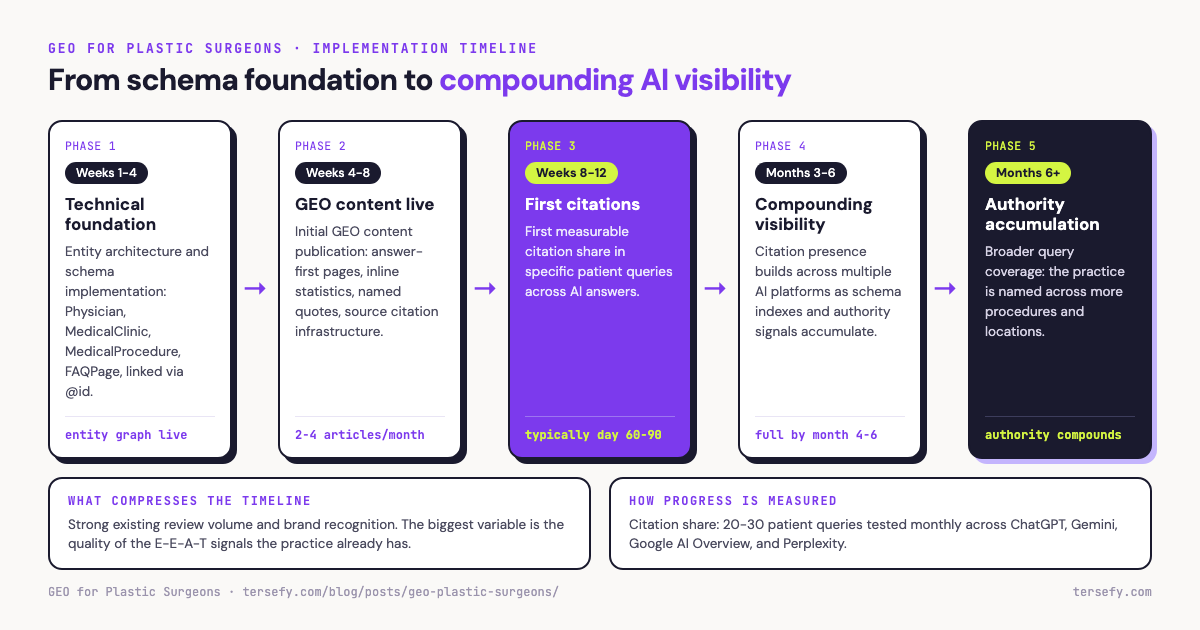
Timeline expectations.
- Weeks 1-4: Entity architecture, schema implementation, technical foundation
- Weeks 4-8: Initial GEO content publication, source citation infrastructure
- Weeks 8-12: First measurable citation share in specific queries
- Months 3-6: Compounding visibility, multi-platform citation presence
- Months 6+: Authority accumulation, broader query coverage
Practices with strong existing review volume and brand recognition compress this timeline. Practices starting from near-zero presence extend it. The single biggest timeline variable is the quality of the existing E-E-A-T signals the practice already has.
What Tersefy Does Differently
Most agencies selling “GEO for plastic surgeons” are SEO agencies adding AI-adjacent language. Tersefy is not.
Three operational differences:
Operator-built methodology. The framework described in this article was developed in production at VIDA Wellness & Beauty Center (Tijuana) by Emilio Alcolea while serving as Chief Sales & Marketing Officer, and refined further while serving as Senior Marketing Consultant for Washington Vascular Specialists (USA). It was not developed in a conference room. It was not modeled from other agencies. Every tactic described here was tested against real patient acquisition data before it was productized.
Citation share measurement, not traffic. Traditional SEO agencies report on impressions, rankings, and clicks. Those metrics are collapsing per 2025-2026 data. Tersefy measures AI citation share: what percentage of patient-relevant queries result in your practice being named across ChatGPT, Gemini, Google AI Overview, and Perplexity. We test monthly with 20-30 queries. If your practice is not cited, we fix it.
Medical tourism specialization as proof of hardest case. Tersefy’s primary market is Tijuana medical tourism clinics, where GEO is structurally harder because patients research in one language and regulatory ecosystem and operate in another. If the framework works for cross-border AI visibility, it works for domestic. Domestic US plastic surgery practices benefit from framework developed for the harder case.
Services start at $1,297 per month per surgeon. Request a free AI citation audit and Tersefy will test 20+ patient prompts across four AI platforms, documenting exactly where your practice is visible and where it is invisible. Report delivered in 3 business days.
Quick answers
What is Generative Engine Optimization (GEO) for plastic surgeons?
Generative Engine Optimization (GEO) is the practice of structuring a plastic surgeon’s digital presence so AI platforms like ChatGPT, Gemini, Perplexity, and Google AI Overview recommend the practice by name when patients research procedures. The term was formalized in a 2024 Princeton research paper (Aggarwal et al., KDD 2024) that demonstrated GEO tactics can boost source visibility in generative engine responses by up to 40%.
How is GEO different from SEO for plastic surgeons?
SEO optimizes for ranking in Google’s ten blue links. GEO optimizes for being cited in AI-generated answers. The Princeton research paper that formalized GEO in 2024 found that traditional SEO tactics like keyword stuffing do not translate to generative engines. The methods that do work (Statistics Addition, Quotation Addition, Cite Sources) boost visibility by up to 40% in AI responses.
How is GEO different from AEO (Answer Engine Optimization)?
AEO optimizes for short-form answers in voice search and featured snippets, typically single-sentence responses. GEO optimizes for long-form AI-generated answers that synthesize 5 to 16 sources into a structured response with multiple cited entities.
Which AI platforms should plastic surgeons optimize for in 2026?
Core stack: ChatGPT (800M+ weekly active users), Gemini Pro, Google AI Overview (48% of all queries, 88% of healthcare queries per theStacc April 2026 data), and Perplexity. Each has different citation patterns. Wikipedia dominates ChatGPT at 7.8% of total citations, Reddit dominates Perplexity.
What schema markup should a plastic surgeon use for AI visibility?
Core stack: Physician schema for surgeon bios with credential and medicalSpecialty properties, MedicalClinic or MedicalOrganization for the practice, MedicalProcedure for each procedure, FAQPage schema, and AggregateRating. Connect entities via @id to create a knowledge graph. Healthcare sites have exclusive access to FAQ rich results in Google search.
Do AI Overviews reduce my Google traffic?
Yes significantly. Seer Interactive documented organic CTR drops of 61% when AI Overviews appear, paid CTR drops of 68%. Healthcare queries trigger AI Overviews 88% of the time per April 2026 data. But brands cited within AI Overviews earn 35% higher organic CTR and 91% higher paid CTR compared to non-cited brands. Citation replaces clicks as the goal.
How long does GEO take to work for plastic surgeons?
Initial citation share typically appears within 60 to 90 days of implementing entity architecture and GEO content. Full compounding visibility takes 4 to 6 months. Practices with existing strong review volume see faster results.
How much does GEO cost for plastic surgery practices?
Tersefy’s GEO plans start at $1,297 per month per individual surgeon. 2-surgeon clinics are $2,297 per month. Multi-surgeon clinics (3+) receive custom pricing starting at $2,997 per month. All plans require a one-time GEO Setup ($1,297). This compares to traditional medical SEO at $1,000-$3,000 per month. Tersefy operates exclusively in GEO for medical practices.
Does GEO replace SEO or complement it?
GEO complements SEO but changes the objective. Traditional SEO tactics still matter for indexation. But with AI Overviews on 48% of queries and 88% of healthcare queries, optimizing only for traditional rankings means optimizing for a shrinking click surface.
What is the single biggest factor in getting cited by ChatGPT?
Authoritative list mentions. When ChatGPT recommends providers, it retrieves from high-ranking best-of articles, comparison pages, and curated directories. Practices appearing in third-party best-of lists for their specialty and location are significantly more likely to be cited.
Should my plastic surgery practice have an llms.txt file?
llms.txt has about 10.13% adoption per SE Ranking’s analysis of 300,000 domains. Multiple studies found no correlation with AI citations. Google stated AI Overviews do not use llms.txt. Implementing it takes under an hour with no downside, but expect no citation uplift from the file alone.
What is the biggest mistake plastic surgeons make with AI visibility?
Treating their own website as the only surface that matters. AI platforms pull from 5 to 16 sources per answer. Reddit accounts for 40.1% of LLM citations, Wikipedia 26.3%, YouTube 23.5%. Practices with deep websites but no third-party presence are invisible.
Do board certifications affect AI recommendations?
Yes, but only when published in structured format. AI platforms weight E-E-A-T signals. Credentials like ABPS board certification, FACS fellowship, or ASPS membership feed directly into E-E-A-T when published in Physician schema with the credential property populated correctly.
How do I measure GEO performance?
The core metric is citation share: what percentage of patient-relevant queries result in your practice being named across ChatGPT, Gemini, Perplexity, and Google AI Overview. Test monthly with 20-30 queries. Track citation presence, citation accuracy, and citation position.
What is E-E-A-T and why does it matter more for plastic surgeons in 2026?
E-E-A-T stands for Experience, Expertise, Authoritativeness, and Trustworthiness. Google uses it to evaluate healthcare content (YMYL). AI platforms mirror this framework. For plastic surgeons, E-E-A-T signals include board certifications in structured data, physician-authored content, hospital affiliations, peer-reviewed publications, and verified patient reviews.